
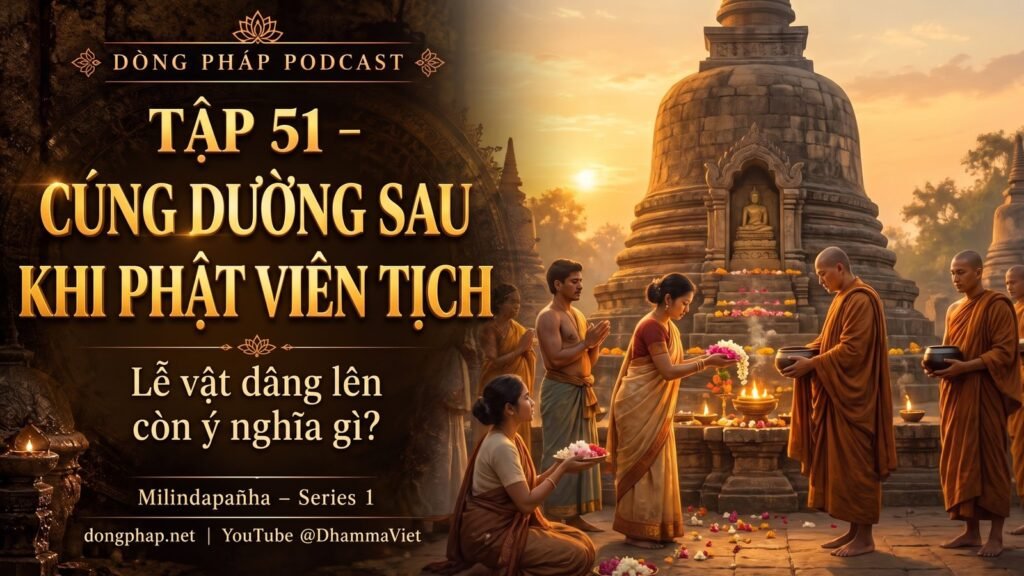
What does it mean to honor the Buddha after his passing?
Before his final passing, the Buddha told Venerable Ānanda not to be occupied with venerating his remains. Yet elsewhere he urged people to venerate the relics of those worthy of veneration. Nāgasena explains: the two teachings are meant for two kinds of people.
Greetings to all of you listening to the Dòng Pháp Podcast. In episode 35 the question was: since the Buddha has entered Nibbāna, do offerings to him still bear fruit? Today the question goes deeper: if the Buddha himself said “do not be occupied with it,” do the stupas and relic processions go against his words?
abyāvaṭa — not occupied, not concerned with that matter.
sadattha — one’s own highest good.
thūpa / cetiya — stupa, shrine.
kicca — duty, task to be done.
PART 1 Two teachings
In the Great Discourse on the Final Nibbāna (DN 16), Venerable Ānanda asks: Lord, what are we to do with the remains of the Tathāgata? The Buddha replies:
“Ānanda, do not be occupied with honoring the remains of the Tathāgata. Strive for your own highest good, devote yourselves to your own highest good…”
But elsewhere there is the advice: venerate the relics of those worthy of veneration; doing so leads to a good destination. King Milinda asks: which statement is correct?
PART 2 Each kind of person has their own duty
Nāgasena answers: the first statement was addressed to the bhikkhus, not to everyone. The duty of those gone forth is to contemplate formations, cultivate meditation and aim for liberation. Organizing the veneration of relics is the duty of devas and lay people.
He gives an example: princes must learn about elephants, horses, chariots, the bow, the sword, letters and laws; ploughing, trading and herding are the work of others. When each person does their own duty well, the country prospers. In the same way, bhikkhus devote themselves to practice and lay followers take care of offerings; both are right, and there is no contradiction.
And indeed, in the sutta, after the Buddha’s passing it was the kings and the people who arranged the funeral, divided the relics and built the stupas. The Saṅgha took care of the recitation council and preserving the teaching.
Monastics uphold the Dhamma through practice. Lay people uphold it through support. Two hands lifting a single lamp.
PART 3 What do relics and stupas mean?
Also in DN 16, the Buddha speaks of four places worthy of pilgrimage: where the Tathāgata was born, attained awakening, set the wheel of Dhamma in motion, and attained final Nibbāna. Those who come to these places with a confident heart will feel joy. He also says there are four kinds of people worthy of a stupa, because when people see the stupa they recall that person’s virtues and their minds become serene.
So stupas and relics are not sacred objects that bestow blessings by themselves. They are reminder bells. Looking at a stupa, one recalls a human being who walked the path to its end; remembering, the mind settles and wishes to follow.
PART 4 Which offering is supreme?
And in the same sutta, when heavenly flowers fall and heavenly music sounds, the Buddha says: it is not by this that the Tathāgata is honored, respected, revered. Whoever lives in accordance with the Dhamma, practicing the Dhamma, honors the Tathāgata with the supreme offering.
For lay people today, lighting a stick of incense or offering a bunch of flowers is beautiful. But when that incense goes together with a day of keeping the precepts, and those flowers go together with gentle speech, the offering becomes complete. For monastics, the instruction “do not be occupied with it” remains fully valid: do not let ceremonies and construction cover up practice.
From offerings, the next question touches a great moral paradox: are non-violence and punishment in contradiction? Next episode.
Thank you for listening. If you found this helpful, please leave a comment, subscribe, like and share it with those who may benefit. Homage to the Blessed One, Śākyamuni Buddha.
• The dilemma: “do not be occupied with venerating the remains” (DN 16) versus “venerate the relics.”
• Nāgasena: the first is for bhikkhus — their duty is practice; the second is for lay people and devas.
• As princes learn the martial arts while others tend the fields: each person has their own duty.
• A stupa is a reminder bell; the supreme offering is living according to the Dhamma.
Text: Milindapañhapāḷi, Meṇḍakapañha — Sarīrapūjāpañha (the simile of the princes and occupations).
Parallels: DN 16 Mahāparinibbāna Sutta (abyāvaṭā; four places of pilgrimage; four kinds of people worthy of a stupa; the supreme offering).
Series Milindapañha – Milinda’s Questions (in Vietnamese) — 72 episodes following the table of contents of the Milindapañhapāḷi.
Listen to and read all 72 episodes in order (in Vietnamese)
🎧 Listen to Episode 51 on YouTube – DhammaViet channel (in Vietnamese)
👉 Watch the video podcast: Milinda’s Questions Episode 51 on YouTube (in Vietnamese) · Full 72-episode playlist (in Vietnamese)
If you found this helpful, please Like, Subscribe to the DhammaViet channel and leave a comment under the video to discuss the Dhamma together. Sādhu! 🙏
Translated from the Vietnamese original: Milinda Vấn Đạo – Tập 51: Cúng dường Đức Phật sau khi Ngài đã viên tịch có ý nghĩa gì?


