
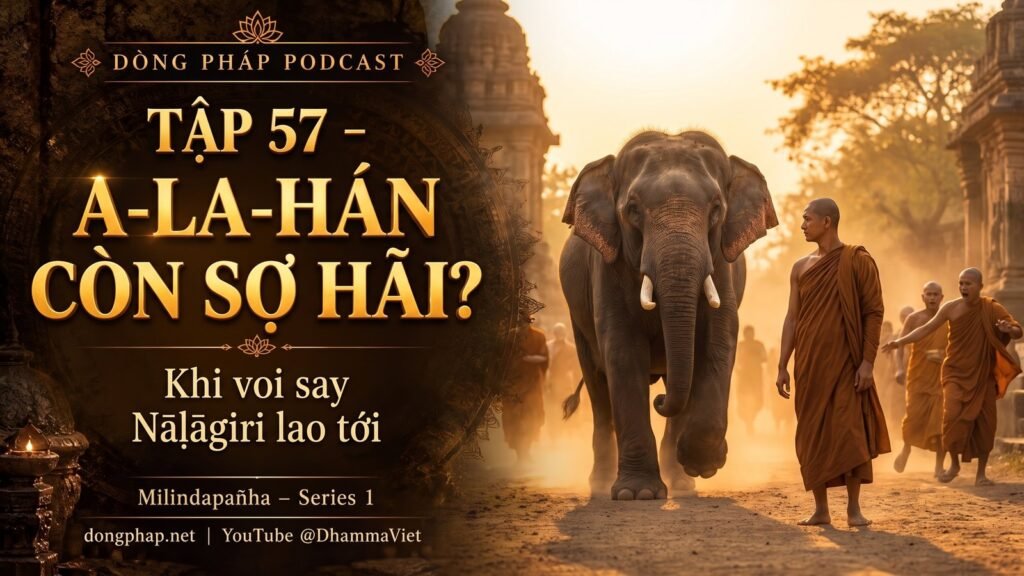
Do arahants still feel fear?
When the drunken elephant Nāḷāgiri charged, the arahants following the Buddha all stepped aside, and only Venerable Ānanda stood in front of the Teacher. Arahants have no fear — so why did they step aside?
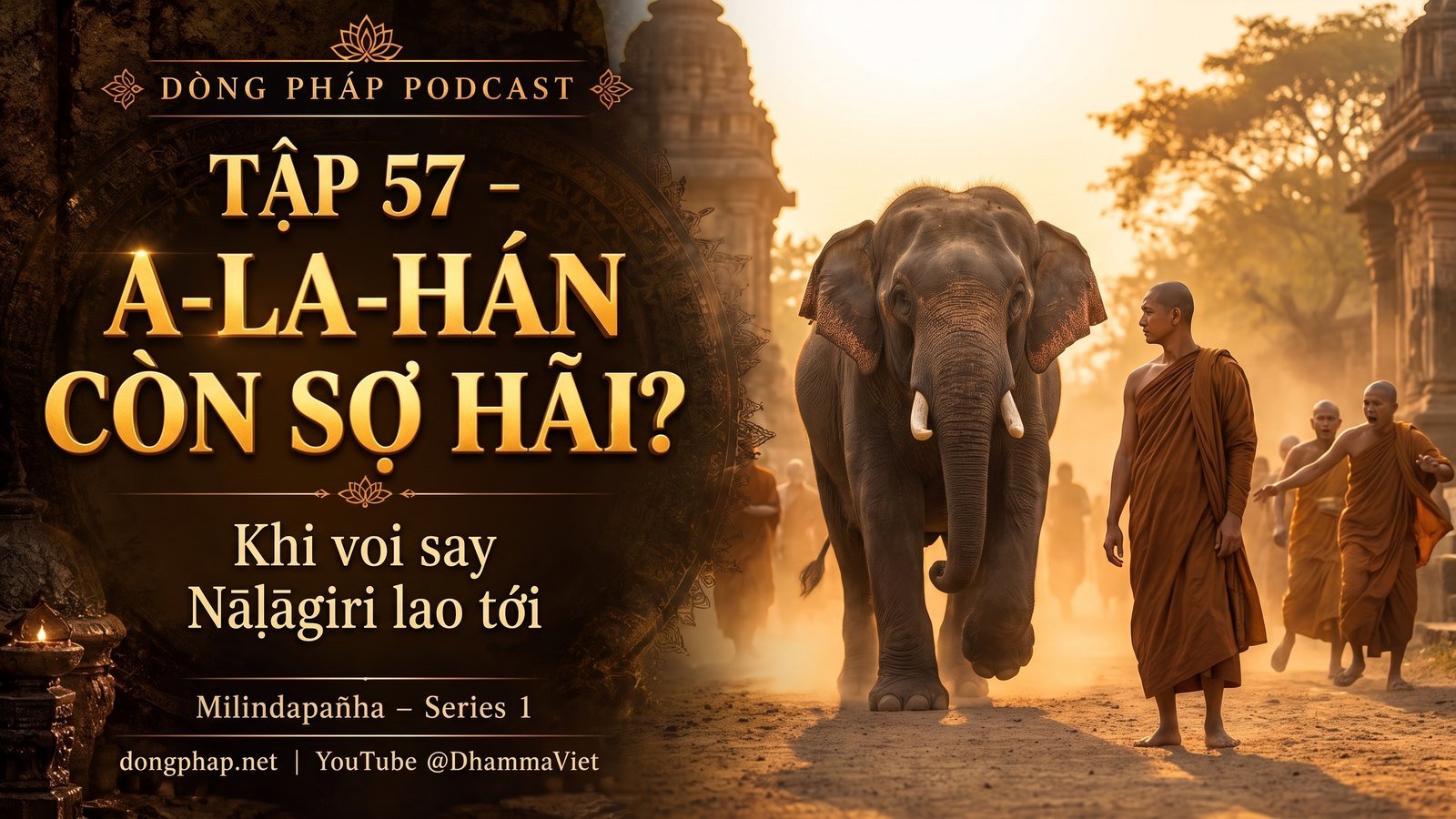
Welcome to everyone listening to Dòng Pháp Podcast. In Episode 44 we said that arahants do not fear death. But there is a scene in the texts that puzzles readers. Devadatta had the fierce elephant Nāḷāgiri made drunk and then released it onto the road where the Buddha was walking for alms. The drunken elephant charged. And the arahants following the Buddha… stepped aside. Only Venerable Ānanda, who at that time had not yet become an arahant, stepped forward and stood in front of the Teacher.
bhaya — fear.
chambhitatta — trembling, terror.
upaṭṭhāka — personal attendant.
mettā — loving-kindness.
PART 1 The two horns
King Milinda asks: it is said that arahants have completely ended all fear and no longer tremble. But when the elephant Nāḷāgiri charged, the arahants abandoned the Buddha and stepped aside, all except Venerable Ānanda. If they were not afraid, why step aside? If they stepped aside out of fear, how can they be said to have ended fear?
PART 2 Stepping aside, not out of fear
Nāgasena replies: the arahants did not step aside out of fear. They had uprooted the very cause of fear. They stepped aside for two reasons.
First, they knew that if they stepped aside, the Blessed One would tame the elephant, and many people would see with their own eyes the power of loving-kindness and gain faith in the True Dhamma. And indeed, the Buddha radiated loving-kindness to the elephant; it calmed down, bowed its head, and let him stroke its forehead. The crowd witnessed it, and a great many people were inspired.
Second, they knew that if they stepped aside, Venerable Ānanda’s devotion would be revealed. An attendant ready to sacrifice his life for his Teacher: that is an example for all ages.
Nāgasena offers similes: just as the earth is not afraid when it is dug, split or burned; the great ocean is not afraid when boats pass over it; the sun is not afraid when clouds cover it. So too the arahant: whether stepping aside or standing firm, it comes not from fear, but from wisdom seeing which is more beneficial.
Not every step back is fear. Sometimes stepping back is to make room for something better to happen.
PART 3 Venerable Ānanda stands in the way
The image of Venerable Ānanda stepping forward to shield the Buddha is one of the most moving moments in the scriptures. Three times the Buddha told Ānanda to step back, and still Ānanda did not move. The commentary says the Buddha had to use his psychic power to move Ānanda aside.
At that time Ānanda was not yet an arahant; he could still be afraid. But his love for his Teacher was greater than his fear. That is a different kind of courage: the courage of someone who is still afraid and does the right thing anyway.
PART 4 Two kinds of fearlessness
The story shows two kinds of fearlessness. The first belongs to the arahant: the roots of fear are gone, so action follows wisdom entirely. The second belongs to the one still in training: there is still fear, but something matters more than the fear, and so it is overcome.
Ordinary people do not yet have the first kind, but we can practise the second. When you are afraid to apologise, afraid to admit a mistake, afraid to stand up for someone weaker, remember Ānanda: the fear may still be there, but it doesn’t have to decide. And learn from the arahants too: before acting, ask which choice brings greater benefit to more people, rather than which makes you look braver.
And finally, the story is a lesson in the loving-kindness discussed in the previous episode: the drunken elephant was not subdued by whips, but by the loving-kindness of an Awakened One.
The next episode returns to a question about the Buddha’s wisdom: in what sense is the Tathāgata omniscient, if he laid down the monastic rules one by one, as occasions arose?
Thank you for listening. If you found this helpful, please leave a comment, subscribe to the channel, like and share it with those who may benefit. Namo Sakyamuni Buddha.
• The dilemma: arahants have no fear, yet they stepped aside from the elephant Nāḷāgiri.
• Nāgasena: they stepped aside so the Buddha could tame the elephant in front of many people, and so Ānanda’s devotion could be revealed.
• Like the earth, the great ocean and the sun, which are not afraid: they act from wisdom, not fear.
• Two kinds of fearlessness: no roots of fear left (the arahant), and still afraid yet doing what is right (Ānanda).
Text: Milindapañhapāḷi, Meṇḍakapañha — Khīṇāsavabhāyanapañha (the story of the elephant Nāḷāgiri).
Compare: Vinaya, Cūḷavagga VII; Jātaka 533 Cūḷahaṃsa (Ānanda shielding the Teacher); Dhammapada commentary.
Previous episode: Episode 56: Mettā – what does loving-kindness really protect? (in Vietnamese) · Next episode: Episode 58: In what sense is the Tathāgata omniscient? (in Vietnamese)
The series Milindapañha – Milinda’s Questions — 72 episodes following the table of contents of the Milindapañhapāḷi. More English translations:
- Milinda’s Questions – Episode 10: Nāma-rūpa – How Do Mind and Matter Live?
- Greed, Hatred and Delusion: The Three Poisons and the Three Unwholesome Roots
- Is Kamma Fate? What Karma Really Means in Buddhism
- Milinda’s Questions – Episode 05: Pubbayoga – A Meeting That Began Long Ago
- Milinda’s Questions – Episode 66: What Is Not Born of Kamma?
Listen to and read all 72 episodes in order (Vietnamese original)
View the whole series →🎧 Listen to Episode 57 on YouTube – DhammaViet channel (in Vietnamese)
👉 Watch the video podcast: Milinda’s Questions Episode 57 on YouTube · Full 72-episode playlist
If you find it helpful, please Like, Subscribe to the DhammaViet channel and leave a comment under the video to discuss the Dhamma together. Sādhu! 🙏


