
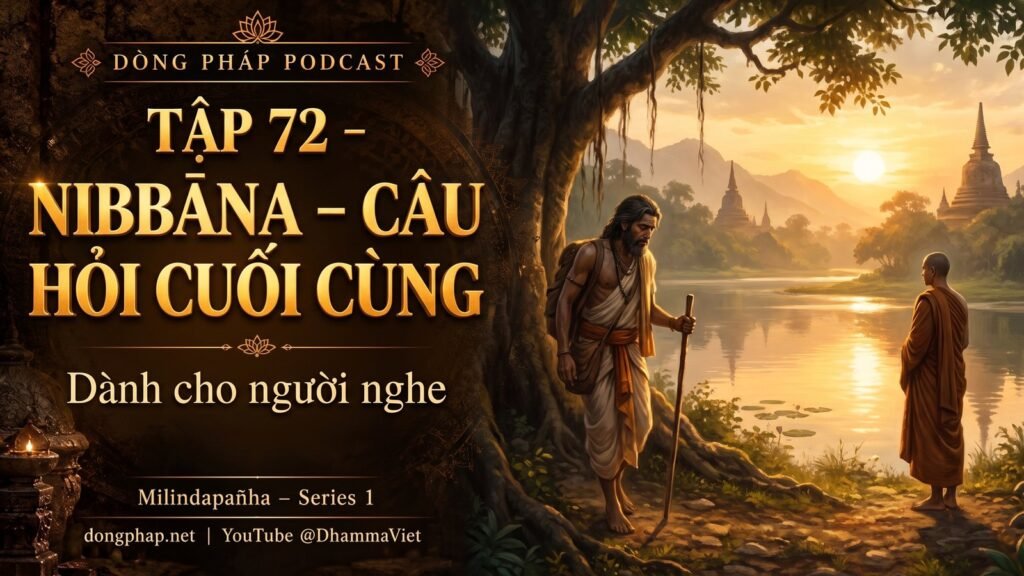
Nibbāna – the final question for the listener
Seventy-one episodes, hundreds of questions, and all of them lead to one point. King Milinda asks four final questions about Nibbāna: is it mixed with suffering, what is its form, how is it realized, and where is it? Then the question is handed back to the listener.
Greetings to everyone listening to Dòng Pháp Podcast. This is the final episode. The journey began in the city of Sāgalā, with an intelligent king searching for someone who could answer him, and a young bhikkhu named Nāgasena. That journey passed through the chariot and the problem of non-self, through the night-long lamp, through the five faculties, through paradoxes about the Buddha, about kamma, about death. Now, every road meets at one point: Nibbāna.
Nibbāna – extinguishing, coolness, the end of greed, hatred and delusion.
Ekantasukha – pure, complete, unmixed happiness.
Appavatta – non-continuance, no longer rolling on.
Sacchikaroti – to realize, to make directly present.
Sīla patiṭṭhā – virtue as foundation, as the ground to stand on.
PART 1 Is Nibbāna mixed with suffering?
The king asked: “Is Nibbāna pure happiness, or is it mixed with suffering?” Nāgasena replied: “Pure happiness.” The king objected: “I see that those who seek Nibbāna torment body and mind: strict rules of discipline, one meal a day, staying up late, sitting long hours, giving up the things they like. So Nibbāna must be mixed with suffering.”
“Ekantasukhaṃ, mahārāja, nibbānaṃ, na dukkhena missaṃ.”
“Great king, Nibbāna is pure happiness, not mixed with suffering.”
Nāgasena made a distinction: that suffering is not Nibbāna, but the suffering involved in seeking Nibbāna. He asked: “Is the happiness of sovereignty mixed with suffering?” “No.” “But when the borderlands rebel, the king must leave the palace, sleep on the ground, be bitten by mosquitoes, fight battles, in order to keep his sovereignty. So is there suffering in sovereignty?” The king understood: the suffering lies in the process of keeping sovereignty, not in sovereignty itself. It is like someone learning a craft: learning is hard work, the teacher is strict, the tasks are many; but once the craft is mastered, one enjoys the pleasure of skill. The suffering lies on the road, not at the destination.
PART 2 Does Nibbāna have a form?
The king asked: “Tell me the form, colour, age and size of Nibbāna, by reasoning, by example.” Nāgasena said: it cannot be done. There is nothing that can be directly compared to Nibbāna. He asked in return: “How much water is there in the great ocean? How many creatures live in it?” The king answered: no one can measure that; it is a question that should not be asked. Nāgasena said: in the same way, the form of Nibbāna cannot be pointed out. Yet a person with psychic power might be able to measure the water of the ocean, and still could not point out the form of Nibbāna.
Although its form cannot be described, Nāgasena could speak of the qualities of Nibbāna through similes. He used ten images; here are some of the most beautiful:
Like the lotus: it is not soiled by muddy water; Nibbāna is not soiled by any defilement.
Like cool water: it soothes fever and quenches thirst; Nibbāna cools the fever of the defilements and quenches the thirst of craving.
Like medicine: it ends all suffering, it is the place where there is no death (amata).
Like the great ocean: it holds no corpses of the defilements; though all rivers flow into it, it is never filled.
Like space: it is not born, does not age, does not die, has no support, cannot be taken away by anyone, is boundless.
Like a mountain peak: it is lofty, unshakable, and the defilements cannot climb it.
Nibbāna cannot be drawn; one can only say it is cool as water, clean as the lotus, vast as the sky.
PART 3 How is Nibbāna realized?
The king asked: “Nibbāna has no form, so how does one who realizes Nibbāna know that they have realized it?” Nāgasena described it: one who practises rightly, contemplating formations (saṅkhāra) arising and passing away, will see in them only birth, ageing, sickness and death; nothing pleasant, nothing worth clinging to. Disenchantment arises in that person’s mind, like someone who has fallen into a blazing heap of fire. Then that mind passes beyond the rolling on (pavatta) into non-continuance (appavatta). One who has attained appavatta is said to have realized Nibbāna.
He gave an example: a person is lost in a dense forest, not knowing the way out, frightened and exhausted. Then that person finds the path out of the forest. That joy, relief and security is known by oneself, with no need for anyone to confirm it. Or like someone drowning who grabs hold of a branch and climbs onto the bank. That person needs no one to tell them they are safe.
PART 4 Where is Nibbāna?
This is the question the king saved for last: “Is there a place where Nibbāna is stored? To the east, the west, the south, the north, above, below?” Nāgasena replied: “There is no place where Nibbāna is stored.” The king said: “Then Nibbāna is not real. If it were real, it would have to have a place.”
Nāgasena used the example of fire: “Is there a place where fire is stored?” “No.” “But when someone rubs two sticks together, fire appears. So is fire not real?” In the same way, Nibbāna has no storage place, but one who practises rightly realizes Nibbāna.
The king asked further: “Then is there a place to stand on in order to realize Nibbāna?” Nāgasena answered: yes. That ground is virtue (sīla). And then he said words that have resounded for two thousand years: one who stands firm on virtue, with wise attention, whether in the land of the Sakas, the Yavanas (Greeks), Cīna (China), Vilāta, in Alasanda (Alexandria), in Nikumba, in Kāsi, Kosala, Kashmir, Gandhāra, whether on a mountain peak or in a heavenly realm, wherever it may be, one who practises rightly realizes Nibbāna. Just as a person with eyes, wherever they are, can see the sky.
“Sīlaṃ, mahārāja, ṭhānaṃ; sīle patiṭṭhito yoniso manasikaronto… yattha katthaci vasanto sammāpaṭipajjamāno nibbānaṃ sacchikaroti.”
“Great king, virtue is the ground; one who stands firm on virtue, giving wise attention, wherever they live, practising rightly, realizes Nibbāna.”
PART 5 Comparison with the Nikāyas and the Abhidhamma
Dhp 204: “Nibbānaṃ paramaṃ sukhaṃ” – Nibbāna is the highest happiness. Ud 8.1: “There is that base where there is no earth, no water, no fire, no air… neither this world nor another world… this is the end of suffering.” SN 38.1: Venerable Sāriputta defines Nibbāna as “the destruction of greed, the destruction of hatred, the destruction of delusion”. AN 9.34: Sāriputta says the happiness of Nibbāna is happiness “where nothing is felt” (avedayita sukha).
The Abhidhamma classifies Nibbāna as the fourth ultimate reality, unconditioned, timeless, the object of the eight supramundane states of consciousness (the four paths and four fruits). Nibbāna has only one nature (santi, peace), but is given two names according to how it is realized: Nibbāna with residue remaining (sa-upādisesa), while the arahant is still alive with the five aggregates; and Nibbāna without residue remaining (anupādisesa), when the five aggregates cease. Nibbāna is also named according to three aspects: signless (animitta), desireless (appaṇihita), and emptiness (suññata).
PART 6 Looking back on the 72-episode journey: from pañha to paññā
These two Pāli words differ only slightly, but that difference is the whole journey. Pañha is a question. Paññā is wisdom. The Milindapañha begins with a king who has a great many questions, and ends with a king who, according to tradition, renounced the throne, went forth and attained arahantship.
Part I opens the door: the city of Sāgalā, King Milinda, Nāgasena, and the vows from past lives. Part II lays the foundation: the chariot, name-and-form, non-self, kamma, rebirth, the night-long lamp. Part III enters the five faculties: faith, energy, mindfulness, concentration, wisdom. Part IV discusses time, mind, memory and the first images of Nibbāna. Part V and Part VI face the thorny questions, the paradoxes that seemed impossible to untangle. Part VII is ethics: speech, trees, non-violence. Part VIII sheds light on the Buddha and the Bodhisatta. Part IX is inference: two Buddhas, householder and renunciant, arahants, the unconditioned. And Part X: Vessantara, good and evil, dedication of merit, dreams, death, and Nibbāna.
One thing stands out throughout all 72 episodes: Nāgasena never forbids the king to ask. He never says “don’t wonder, just believe”. He answers with chariots, mangoes, lamps, boats, sticks, grains of rice. The Dhamma is taught with the very objects of everyday life, which means the Dhamma belongs to everyday life.
PART 7 One last everyday example
Some people look for happiness the way they look for an address on a map: they type “Nibbāna” into their phone and wait for the location. The map says: “Location not found.” Disappointed, they say: “So it isn’t real.” Nāgasena would say: right, there is no location. But each time anger has just arisen and is seen clearly and settles down, that is a little coolness, a little taste of extinguishing. No need for a location; you only need to stop.
And if anyone has listened to all 72 episodes and still has questions, that is good news. King Milinda did too. It was precisely the questions that made this book.
PART 8 Meaning for Vipassanā practitioners, and the question for the listener
What Nāgasena says about how Nibbāna is realized is exactly the map of Vipassanā: contemplate formations arising and passing away; see that they are not worth clinging to; the mind grows disenchanted, lets go; and when it lets go completely, the mind passes beyond the current of rolling on. Not one step requires going somewhere far away. The ground is virtue; the tool is wise attention; the place of practice is anywhere, including the home, the office, the hospital, the bus.
So the final question of the series no longer belongs to King Milinda. It belongs to the one who is listening:
Is my virtue firm today? Is my attention wise at this moment? And right in this breath, am I seeing phenomena arise and pass away, or am I dreaming a “monkey-style” dream?
The answer is not in the book. It is in the place where you are sitting, right now.
Thank you for accompanying Dòng Pháp Podcast through all 72 episodes of the Milindapañha – The Questions of King Milinda. If you found this helpful, please leave a comment, subscribe to the channel, like, and share it with those who have the affinity. May all beings be happy and soon see the way out of the forest. Homage to the Buddha Shakyamuni, our Fundamental Teacher.
• Nibbāna is pure happiness; suffering lies only on the road of seeking, just as the hardship of defending sovereignty is not sovereignty itself.
• Nibbāna has no form or size, but it has qualities: clean as the lotus, cool as water, vast as space, lofty as a mountain peak.
• Realizing Nibbāna: contemplating the arising and passing of formations, the mind passes from rolling on (pavatta) to non-continuance (appavatta), like a lost traveller finding the way out of the forest.
• Nibbāna has no storage place, just as fire has no storehouse; but there is a ground to stand on to realize it: virtue, anywhere at all.
• The 72-episode journey goes from pañha (question) to paññā (wisdom); the final question is handed back to the listener.
Text: Milindapañha, Vessantaravagga and Nibbānavagga – Ekantasukhanibbānapañho, Nibbānarūpasaṇṭhānapañho, Nibbānasacchikaraṇapañho, Nibbānasannihitapañho.
Comparison: Dhp 204; Ud 8.1–8.3; SN 38.1; AN 9.34; It 44 (the two Nibbāna elements); Abhidhammatthasaṅgaha chapter VI; Visuddhimagga XVI on Nibbāna.
Translated from the Vietnamese original: Milinda Vấn Đạo – Tập 72: Nibbāna – câu hỏi cuối cùng dành cho người nghe
Series Milindapañha – The Questions of King Milinda — 72 episodes following the table of contents of the Milindapañhapāḷi. This is the final episode.
Listen to and read all 72 episodes in order
🎧 Listen to Episode 72 on YouTube – DhammaViet channel (in Vietnamese)
👉 Watch the podcast video: The Questions of King Milinda Episode 72 on YouTube (in Vietnamese) · Playlist of all 72 episodes (in Vietnamese)
If you found this helpful, please click Like, subscribe to the DhammaViet (in Vietnamese) channel and leave a comment under the video to share in the Dhamma. Sādhu! 🙏


