
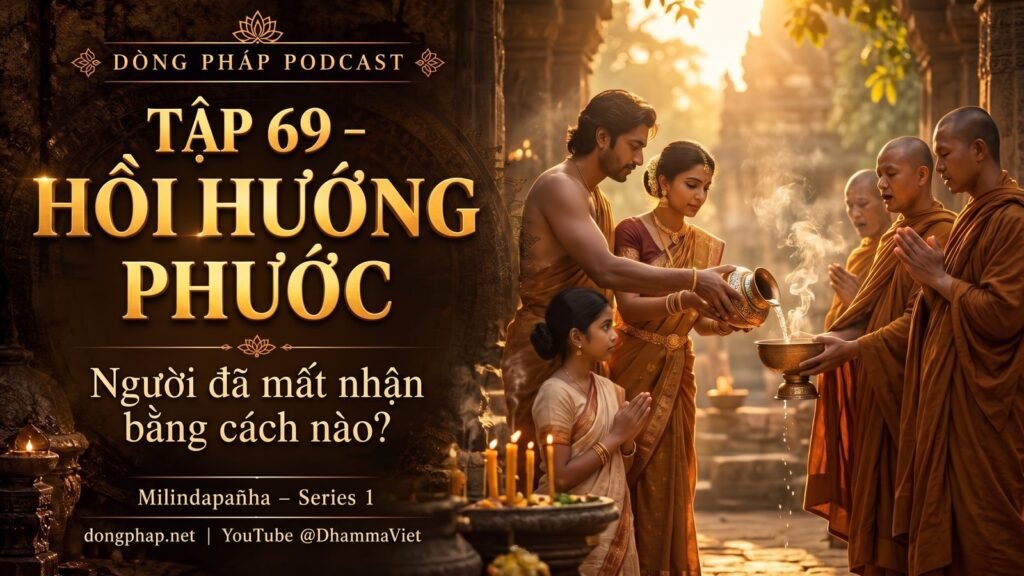
Dedicating Merit: How Do the Departed Receive It?
A tray of offerings, the chanting of a sutta, a cup of water poured onto the ground. Every Vietnamese family has performed a dedication of merit for grandparents and parents. But does that merit really reach them? And why can merit be shared while demerit cannot?
Welcome, dear listeners of the Dòng Pháp Podcast. The previous episode showed that merit can spread like water flooding over a field. This episode asks the next question: can that water flow into someone else’s field, especially someone who has already left this world? For Vietnamese people this is not a remote philosophical question; it is part of every death anniversary and every Vu Lan (Ullambana) season.
Pattidāna – dedicating merit, sharing a portion of merit.
Pattānumodanā – rejoicing, gladly accepting the share of merit offered.
Peta – hungry ghost, a being reborn after death in a realm of hunger and thirst.
Paradattūpajīvī peta – the kind of hungry ghost that lives on what others give.
PART 1 King Milinda’s question
The king asked: “Those who give gifts and then dedicate them to departed relatives, saying ‘May this merit reach them’ — do the dead receive any result from that?” Nāgasena replied: “Some receive it, some do not.”
The king pressed on: who receives it, and who does not? And if they do not receive it, is that giving wasted? Then he asked his sharpest question: “If merit can be shared, can demerit be shared too? What if someone does evil and then dedicates that evil to another person?”
“Kusalaṃ sakkā saṃvibhajituṃ, na akusalaṃ.”
“The wholesome can be shared; the unwholesome cannot.”
PART 2 Nāgasena’s answer: who receives it?
Nāgasena lists them: beings reborn in hell do not receive it; beings reborn in the heavens do not need it; animals do not receive it. Of the four kinds of hungry ghosts, three cannot receive it: those who feed on vomit (vantāsika), those tormented by hunger and thirst (khuppipāsika), and those consumed by the fire of craving (nijjhāmataṇhika). Only the fourth kind, the hungry ghosts who live on what others give (paradattūpajīvī), can receive it — and only when they remember the relatives who are making merit for them.
So is giving dedicated to someone who cannot receive it wasted? Nāgasena says: no. The giver still receives the full share of their own result. He gives a comparison: someone brings fish, meat, wine and cakes to visit relatives; if those relatives do not accept them, the goods are not lost at all — they go back to their owner. Merit is the same: if it is dedicated and the other cannot receive it, the merit still belongs to the one who made it.
PART 3 Why can demerit not be shared?
Nāgasena gives two reasons. First: another person who has not agreed to receive it and did not take part in the deed cannot bear the demerit in your place. An innocent person cannot be forced to shoulder an act they did not do — just as water cannot be channelled up a high mountain through a ditch.
Second, and this is the most beautiful image: the unwholesome is small, the wholesome is great. A drop of water falling on dry ground soaks into that spot only; it does not spread ten or twelve yojanas. But when a great rain pours down, water floods the whole land, runs into ponds, lakes, streams and rivers and spreads everywhere. Demerit is like the drop of water: small and narrow, clinging only to the one who did it. Merit is like the rain: vast, able to spread to others.
Demerit is a drop of water soaking into one spot; merit is a rain flooding the whole field.
PART 4 Explanation: how does merit “travel”?
We need to understand this correctly: merit is not a parcel handed from one person to another, leaving the giver with less. When dedicating merit, the one who made the merit loses nothing at all; on the contrary, the generous mind that dedicates it is itself a new act of merit.
On the receiving side, what really happens is this: when the departed (of the kind of hungry ghost able to receive it) learns of the good deed of their relatives and gives rise to a mind of rejoicing — “Sādhu, sādhu” — that very rejoicing is a wholesome kamma of their own. This wholesome kamma bears fruit immediately: food, clothing and shelter in their realm. In other words, the departed receive by making merit themselves through rejoicing, stirred by the deeds of the living.
PART 5 Comparison with the Nikāyas and the commentaries
Khp 7 and Pv 1.5: hungry ghosts stand outside the walls, at crossroads, by the doors of their former homes. When relatives give and dedicate, “May this be for our relatives”, those hungry ghosts rejoice and are made happy. “There is no ploughing there, no herding, no trading… they live on what is given from here.” The sutta also teaches: weeping and grieving do not help the departed.
AN 10.177 (Jāṇussoṇi Sutta): the Buddha answers the brahmin Jāṇussoṇi that offerings made for the dead reach only those reborn in the realm of hungry ghosts; and the one who makes the offering is never without benefit.
The commentary tells the story of King Bimbisāra: the king’s relatives from a former life were hungry ghosts, and at night they wailed around the palace because the king had made offerings without dedicating the merit. The next day the king made offerings to the Buddha and the Saṅgha and then dedicated the merit; the hungry ghosts obtained food and clothing and were freed from suffering. This is the occasion on which the Discourse Outside the Walls was given. In the Abhidhamma, rejoicing (anumodanā) is listed as one of the ten bases of meritorious action (puññakiriyavatthu), a great wholesome sense-sphere mind.
PART 6 Everyday examples
Dedicating merit is like lighting a candle in the night and calling out the name of a loved one. If that person is nearby, hears it and looks toward the light, they will find their way. If that person is too far away, already in another city, the candlelight will not reach them. But the candle still shines, and the room of the one who lit it is still warm.
As for demerit not being shareable, everyone has experienced it: try telling your younger sibling, “I broke the vase, so you take the blame for me, okay?” When Mum gets home, one look and she knows. And even if your sibling really does take the blame, the one who broke it still feels uneasy for the whole week. No one can take that “result” away.
And there is something rather comical at many death-anniversary gatherings: the feast is laid out beautifully, the incense smoke rises thickly, yet the family members are shouting at each other over dividing up the land. If the grandparents really are standing “outside the walls”, one wonders whether they would rejoice at the feast or grieve for their descendants.
PART 7 Meaning for the Vipassanā practitioner
Dedicating merit is a way for the mind not to be stingy, even with its own merit. After each meditation session, one can dedicate: “May the merit of this sitting reach all beings.” This does not diminish the merit; it broadens the mind, and a broad mind settles into concentration more easily.
For someone carrying the pain of losing a loved one, the Discourse Outside the Walls is practical medicine: weeping helps no one; do a good deed, keep the precepts, sit in meditation, and then dedicate the merit. The pain is turned into action, and that action benefits both the living and the departed.
As for demerit, the lesson is clear: no one can carry it for you, and it cannot be pushed away by ritual. The only way is to stop doing it, and to do a great deal of good to “dilute” it, like the handful of salt in the river from the previous episode.
Thank you for listening. If you found this helpful, please leave a comment, subscribe, like and share it with those who may benefit. Homage to our root teacher, Shakyamuni Buddha.
• Dedicated merit reaches only the kind of hungry ghost that lives on what others give (paradattūpajīvī), when they know of it and rejoice.
• The one who dedicates never loses merit; if the other cannot receive it, the merit returns to the doer.
• Demerit cannot be shared: others did not take part and did not consent; and demerit is small like a drop of water, merit vast like a rain.
• Discourse Outside the Walls: weeping does not help the departed; giving and dedicating merit does.
• Open question: when we sleep, where does the mind go, and where do dreams come from?
Text: Milindapañha, Meṇḍakapañha – Petānaṃ dānānumodanāpañho; Kusalākusalasaṃvibhajanapañho.
Comparison: Khp 7 / Pv 1.5 Tirokuḍḍa Sutta; AN 10.177 Jāṇussoṇi Sutta; Khuddakapāṭha-aṭṭhakathā on King Bimbisāra.
Series Milindapañha – The Questions of King Milinda — 72 episodes following the table of contents of the Milindapañhapāḷi. More translated articles:
- What Is Theravāda Buddhism? A Complete Guide
- Namo Tassa Bhagavato Arahato Sammāsambuddhassa: Discovering Its Sacred Meaning
- Episode 1: What Is the Sūtra of Immeasurable Life? Why Read It in the Light of the Pāli Canon?
- What Is the Pāli Canon (Tipiṭaka)? A Complete Guide
- Where Does Language Reach Its Limit?
Listen to and read all 72 episodes in order (Vietnamese original)
🎧 Listen to Episode 69 on YouTube – DhammaViet channel (in Vietnamese)
👉 Watch the podcast video: The Questions of King Milinda, Episode 69 on YouTube (in Vietnamese) · Full 72-episode playlist (in Vietnamese)
If you found it helpful, please Like, subscribe to the DhammaViet channel and leave a comment under the video to share in the Dhamma. Sādhu! 🙏
Translated from the Vietnamese original: Milinda Vấn Đạo – Tập 69: Hồi hướng phước: người đã mất nhận bằng cách nào?


