
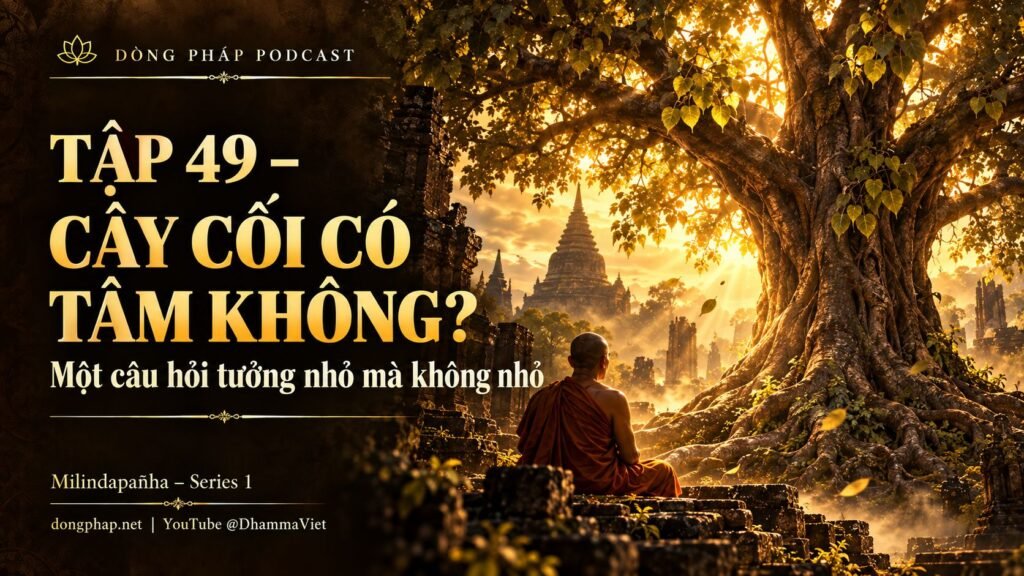
Do Trees Have a Mind?
In a Jātaka story a tree is said to have no mind — “why speak to a tree?” Yet in that same story the tree answers back. Nāgasena unties the knot: the speaker is the tree deity, and “the tree” is just a manner of speaking.
Welcome, dear listeners of the Dòng Pháp Podcast. In Vietnamese villages, the great banyan tree at the village gate often has a small shrine, and people believe a tree spirit lives there. Modern science, for its part, says trees can “sense” light and gravity and even “communicate” with each other through their roots. So do trees have a mind? The Milindapañha has a very interesting question about this.
rukkhadevatā — tree deity, a deva dwelling in a tree.
bhūtagāma — plants and vegetation (literally “a village of living things”).
vohāra — ordinary manner of speaking.
jīvasaññī — one who perceives that there is life.
PART 1 A talking tree?
In one Jātaka story, a verse addresses a brahmin: “Brahmin, why do you speak to this insentient tree that cannot hear anything?” Yet in that very story, the tree answers the brahmin. King Milinda asks: if the tree is insentient, it cannot speak; if the tree can speak, it is not insentient. The two statements clash.
PART 2 The speaker is the tree deity
Nāgasena replies: the tree is insentient; it has no mind. The one speaking is the tree deity who dwells in the tree. But in ordinary usage, people say “the tree spoke”.
He gives an example: a cart loaded with grain is called a “grain cart”. The cart is not made of grain, but because it carries grain it is called that. Likewise, because the tree deity dwelling in the tree speaks, people say “the tree spoke”. Just as we say “the whole village went to the festival”, even though the village itself did not get up and walk.
This is again the lesson about conventional language we have met many times: ordinary speech is not always correct in the ultimate sense. A reader of the suttas needs to tell the two apart.
Everyday language is convenient, but don’t let it deceive you about the nature of things.
PART 3 If trees have no mind, why not cut them down?
An interesting detail: in the Vinaya, a monk commits an offence if he cuts or destroys plants (bhūtagāma). If trees have no mind, why the prohibition? The Vinaya explains the origin: people at the time believed plants had life, and they criticised monks they saw cutting trees. The Buddha laid down the rule to avoid causing people to lose faith, and also to cultivate an attitude of respect and gentleness toward nature.
According to the Abhidhamma, trees have plant life — they grow and respond — but they have no mind (citta) in the sense of knowing, and no pleasant or painful feeling. Even so, nature is a refuge for countless beings who do have minds: birds build nests, insects shelter there, and according to traditional belief, even devas dwell there. To cut down a tree is to destroy a shared home.
PART 4 Living gently with nature
The Buddha was born under an Asoka tree in the Lumbinī garden, awakened under the Bodhi tree, and entered final Nibbāna between two Sāla trees. His whole life was bound up with trees. Pāli literature tells of monks who sat under a tree, enjoyed its shade, and then would not break its branches or pick its leaves, out of gratitude. There is also the teaching that one who has sat in a tree’s shade should not break that tree’s branch — an example of gratitude in Pāli literature.
People today can learn from that spirit: plant a tree, tend a pot of flowers, don’t leave rubbish in forests and mountains, don’t break branches at temples. Not because the tree has a mind that grieves when broken, but because our own mind becomes gentler when we learn to cherish the life around us.
When you meditate outdoors, notice: the rustling of leaves is sound, the shade is a pleasant sensation on the skin, the smell of earth is odour. Nature does not need a mind to become a teacher of the mind.
From trees, the next question turns to a meal: why can offering a single meal bring great fruit? Next episode.
Thank you for listening. If you found this helpful, please leave a comment, subscribe, like and share it with those who may benefit. Namo Sakyamuni Buddha.
• The dilemma: an insentient tree that nevertheless speaks in a Jātaka story.
• Nāgasena: the tree has no mind; the speaker is the tree deity; “the tree spoke” is ordinary usage, like “grain cart”.
• The Vinaya forbids destroying plants to preserve people’s faith and to cultivate respect for nature.
• Living gently with nature makes the mind gentle; nature is a teacher of the mind.
Text: Milindapañhapāḷi, Meṇḍakapañha — Rukkhaacetanāpañha (the grain-cart simile).
Comparison: Vinaya, Pācittiya 11 (bhūtagāma); Jātaka 307 Palāsa; the Abhidhamma on jīvitindriya and citta.
Series Milindapañha – The Questions of King Milinda — 72 episodes following the outline of the Milindapañhapāḷi. More translated articles:
- Episode 21: A Dried Dung Stick – Asked “What Is Buddha?”, Why Such a Shocking Answer?
- What Are the Five Aggregates? The Five Parts of a “Person”
- The Three Marks of Existence: Impermanence, Dukkha, Non-Self
- Episode 08: Maṅgala Sutta – Do Blessings Come from Chanting or from How We Live?
- What Is Dependent Origination (Paṭiccasamuppāda)?
Read and listen to all 72 episodes in order (Vietnamese original)
🎧 Listen to Episode 49 on YouTube – DhammaViet channel (in Vietnamese)
👉 Watch the video podcast: Episode 49 on YouTube · Full 72-episode playlist
If you found it helpful, please like, subscribe to DhammaViet and leave a comment under the video to share in the Dhamma. Sādhu! 🙏


