
Xiangyan up a tree: when speaking won’t do, and silence won’t either
Comparing the koan “Xiangyan Up a Tree” 香嚴上樹 with right speech, wise attention, the Buddha’s silence, and the path beyond clinging in the Nikāyas.

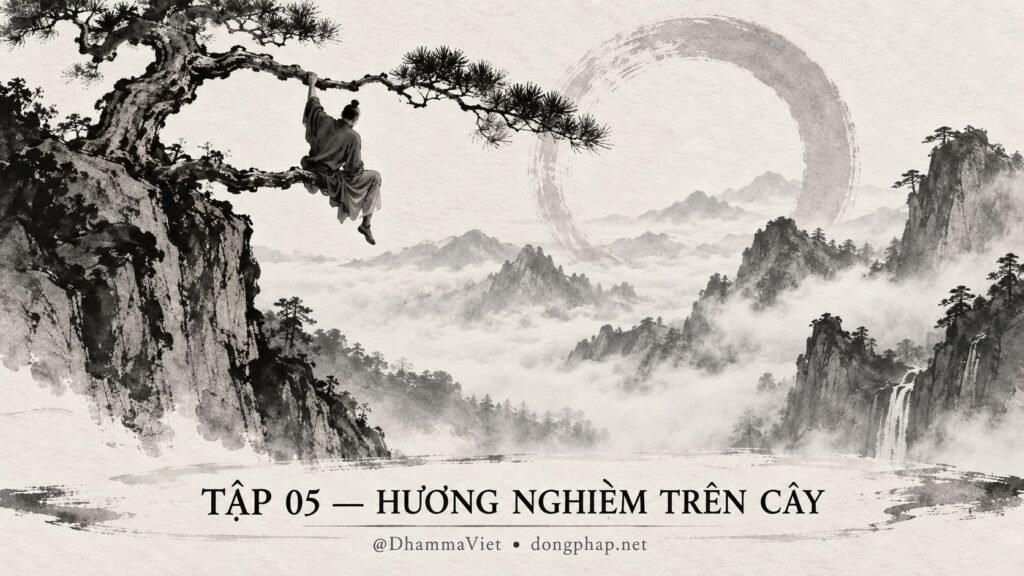
Xiangyan up a tree puts the student in a bind: his teeth clamped on a branch, someone below asks about the meaning of the Patriarch’s coming from the West; answer and he falls, don’t answer and he fails the one who asked. Read against the Pāli Canon, not every question needs a yes or no: AN 4.42 sets out four ways of answering, MN 63 shows there are issues that do not directly lead to the end of suffering, and MN 58 teaches that true and beneficial words must be spoken at the right time. This is a comparison for practice, not the only solution to the koan.
Greetings to everyone listening to Dòng Pháp Podcast. Today’s episode introduces the fifth koan of the Gateless Gate by Chan master Wumen Huikai, called “Xiangyan Up a Tree” — a situation that, just hearing it, sounds more awkward than being asked at the family dinner table when you’re finally getting married.
The koan tells that Chan master Xiangyan said:
A man is up a tree, his teeth clamped tightly on a branch, his hands holding onto nothing, his feet resting on no bough.
Suddenly someone standing beneath the tree asks:
What is the meaning of the Patriarch’s coming from the West?
If the man in the tree does not answer, he fails the one who asked.
If he opens his mouth to answer, he instantly falls to his death.
So in that situation, what should he do?
It is truly an awkward situation.
Answer, and you fall.
Don’t answer, and you get a reputation for being unhelpful.
And the person standing under the tree also deserves some thought. Seeing someone else dangling between life and death, instead of calling for rescue, he asks about the meaning of Chan.
If this happened today, the man in the tree would probably just want to shout:
Call an ambulance first, we’ll discuss Bodhidharma later!
But the koan is not meant to teach tree-climbing skills.
It places the student before a paradox: when every familiar option leads to a dead end, is there another way of seeing?
And in the light of the Pāli Canon, that question can lead to a very practical issue: When should we speak, when should we keep silent, and when is the very urge to answer the thing that needs to be observed?
PART 1 Why do people always want an answer?
In life, some questions are very simple.
Have you eaten?
What time is it?
Will it rain today?
But some questions come with a built-in trap.
Which of these two people do you think is better-looking?
Choose the first, and the second is hurt.
Choose the second, and the first is upset.
Say they’re both good-looking, and you may be thought insincere.
Stay silent, and you’ll be asked:
Why don’t you dare to answer?
The mind tends to believe that every question must have an immediate answer.
But in the Pāli Canon, the Buddha does not answer every question in the same way.
In AN 4.42, he presents four ways of answering:
Ekaṃsabyākaraṇīya pañha — a question to be answered categorically.
Vibhajjabyākaraṇīya pañha — a question to be answered by analysing and distinguishing.
Paṭipucchābyākaraṇīya pañha — a question to be answered with a counter-question for clarification.
Ṭhapanīya pañha — a question to be set aside.
This is well worth noting.
Not every question needs a yes-or-no answer.
Not every problem can be solved with a slogan.
And silence in the face of a question does not always mean ignorance.
Sometimes wisdom begins with recognizing that a question rests on unsuitable assumptions.
PART 2 Where is the man in the tree stuck?
In the koan, the man in the tree is given only two options.
Speak and die.
Don’t speak and fail the questioner.
But why must we accept those two options as the whole of reality?
This is a point that can be compared with yoniso manasikāra, wise attention.
In MN 2, the Sabbāsava Sutta, the Buddha distinguishes wise attention from unwise attention.
Ayoniso manasikāra is attention in the wrong direction, which can nourish the taints.
Yoniso manasikāra is attention in the right direction, which can help abandon the taints.
Someone who has been insulted usually thinks:
How should I hit back so that I win?
But that is not necessarily the most useful question.
A more fitting question might be:
What is driving the mind right now?
Is anger arising?
Is there clinging to reputation or self-image?
If I don’t react right away, what actually happens?
Sometimes people suffer not because they have no options.
But because they see only the options built by greed, hatred and delusion.
The man in the tree can be seen as an image of a mind stuck in a dualistic structure.
But note: this is a comparison for practice, not the only solution to the koan in the Chan/Zen tradition.
PART 3 Did the Buddha ever keep silent?
Yes.
But the Buddha’s silence did not always carry the same meaning.
In MN 63, the Cūḷamāluṅkya Sutta, the Venerable Māluṅkyaputta wanted the Buddha to resolve metaphysical questions.
Is the world eternal or not eternal?
Is the world finite or infinite?
Are the life-principle and the body the same or different?
Does the Tathāgata exist after death or not?
The Buddha did not settle these questions as the bhikkhu demanded.
He gave the famous simile of a man struck by a poisoned arrow.
That man refuses to let the surgeon pull the arrow out until he knows who shot it, what clan he belongs to, what material the bow is made of and what the arrow looks like.
If he waits for every answer, he may die before he is treated.
The Buddha pointed out that such speculations do not directly lead to dispassion, cessation, peace and Nibbāna.
What he taught is suffering, the origin of suffering, the cessation of suffering and the path leading to the cessation of suffering.
Imagine someone with a terrible toothache.
The dentist proposes treatment.
But the patient says:
Wait, first we need to determine whether the universe is infinite.
If the universe is finite, where does this tooth stand within the totality of existence?
Meanwhile, the tooth keeps on aching with great enthusiasm.
Not every philosophical question is worthless.
But when suffering needs to be ended, some things must be given priority.
A person who knows how to pause before reacting is not doing so out of weakness.
PART 4 Right speech does not mean telling the truth at every moment
Some people understand right speech simply as saying what is true.
But in the Nikāyas, right speech also involves timing, benefit, motive and appropriateness.
In MN 58, the Abhayarājakumāra Sutta, the Buddha explains that he does not speak words that are untrue and unbeneficial.
As for words that are true and beneficial, he knows the proper time to speak them, even if they may be unwelcome to the listener.
This is a very profound principle.
Knowing something true does not mean you must say it immediately.
Someone has just made a mistake.
You can offer feedback.
But giving it in front of hundreds of people, in a sarcastic tone, can cause unnecessary hurt.
Someone is grieving.
You can speak about impermanence.
But if, having just heard that a loved one has died, they are immediately given a long talk on arising and passing away, they may need presence and compassion more than a sermon.
Even the right Dhamma needs to be applied with wisdom and compassion.
Sammāvācā, right speech, is not the art of telling as much truth as possible.
Nor is it a technique for winning every argument.
It is training speech in the direction of harmlessness and benefit.
PART 5 Silence can also be a form of clinging
Some people love to talk.
They comment on everything.
They explain before anyone has asked.
Someone else has barely spoken three words, and they have already delivered a three-page conclusion.
But some people love silence so much that they turn silence into a self-image.
Not answering for fear of being wrong.
Not giving feedback for fear of displeasing others.
Not admitting mistakes in order to look calm.
Some even stay silent to make others uncomfortable.
Outwardly, not a word.
Inwardly, a full press conference is under way.
So silence is not automatically the same as wisdom.
In Dhammapada 268–269, the Buddha points out that one does not become a sage merely by keeping silent.
The wise one who weighs the wholesome and the unwholesome and abandons evil is the one worthy to be called a sage.
What matters is not only whether one speaks or not.
But how the mind is operating.
Is there craving?
Is there hatred?
Is there delusion?
Is there compassion and understanding?
A short remark can be very wholesome.
A silence can be very well-timed.
But both can also be used to feed the ego.
PART 6 Xiangyan up a tree and the raft in the Pāli Canon
In MN 22, the Alagaddūpama Sutta, the Buddha uses the simile of the raft.
A man who wants to cross a dangerous stretch of water binds grass, branches and other materials into a raft.
Thanks to the raft, he reaches the far shore.
After that, if he keeps carrying the raft on his shoulders because he thinks it too precious, he has misunderstood how to use the means.
The Buddha taught:
Nittharaṇatthāya no gahaṇatthāya.
For the purpose of crossing over, not for the purpose of grasping.
Language too can be seen as a means in learning and transmitting the Dhamma.
Through words, the student understands the Four Noble Truths.
Through the texts, the Dhamma is preserved across generations.
Through explanation, misunderstandings can be cleared up.
But when words become an object of clinging, they can obstruct practice.
Someone argues for years over the definition of letting go.
He may win every debate.
But still be unable to let go of his anger when someone disagrees.
The raft has become luggage.
Instead of carrying him across the river, it is polished and displayed in the living room.
The Xiangyan koan can remind the student not to absolutize either speech or silence.
But that does not mean language is useless.
In the Nikāyas, the Buddha uses words abundantly to guide the path of liberation.
The point is not to eliminate language.
It is to use language for the right purpose.
PART 7 When you cannot speak, observe the mind that wants to speak
Try a practice in daily life.
When someone makes a remark you dislike, don’t rush to reply.
First, recognize the feeling.
Is there discomfort?
Is your face getting hot?
Is your heart beating faster?
Next, observe the intention.
Do you want to explain in order to clarify the truth?
Or do you want to prove the other person wrong?
Do you want to protect what is right?
Or do you want to protect your self-image?
Then examine the words you are about to say.
Are they true?
Are they beneficial?
Is it the right time?
Can they be expressed without feeding anger?
If you need to speak, speak.
If you need to be silent, be silent.
If you need to ask more in order to understand, ask.
If you need to apologize, apologize.
You don’t have to choose between the two extremes of speaking at all costs and keeping silent at all costs.
This is a practice combining sati, mindfulness; sampajañña, clear comprehension; and sammāvācā, right speech.
A person who knows how to pause before reacting is not doing so out of weakness.
Sometimes it is a sign of maturity in recognizing the mind.
PART 8 Climb down from the tree before debating awakening
Back to the koan.
A man is hanging from a tree.
Teeth clamped on a branch.
Hands holding nothing.
Feet resting on nothing.
Below, someone asks about the meaning of the Patriarch’s coming from the West.
Open the mouth, and he falls.
Keep it shut, and he fails the questioner.
A student could spend many years searching for an original answer.
But in the light of the Pāli Canon, a more practical question appears:
What is making the mind accept that deadlock?
Is it the urge to answer?
Is it the fear of being judged?
Is it clinging to the image of someone who understands the Way?
Or is it too narrow a view of the options that are actually present?
In life, quite a few people are hanging from invisible branches.
A branch called reputation.
A branch called success.
A branch called always having to be right.
A branch called never letting anyone down.
Teeth clamped tight.
Mind tense.
Yet still trying to answer every question the world asks.
Perhaps what is needed is not to find a brilliant thing to say while dangling in mid-air.
But to recognize the clinging that keeps the mind in that state.
In the Pāli Canon, liberation is not the achievement of answering every paradox.
Liberation is bound up with the destruction of greed, hatred and delusion.
A person may not be able to solve every koan.
But if they know how to speak words that are true, timely, beneficial and harmless, they are practising an important part of the Noble Eightfold Path.
A person may not be able to give an answer that astonishes the assembly.
But if they know how to recognize anger before it turns into words, they are protecting both themselves and others from suffering.
And a person may not yet fully understand the meaning of silence in Chan.
But if they know how to keep silent when words would only wound, and to speak up when what is right needs defending, that practice already has value.
Not every question needs an immediate answer. Not every silence is wisdom. And not every true word is spoken at the right time.
That is what the koan of Xiangyan up a tree can open up when compared with the Pāli Canon.
2. Examine the intention. Observe whether you want to clarify the truth or prove the other person wrong, to protect what is right or to protect your self-image.
3. Four questions before speaking. Consider whether what you intend to say is true, beneficial, timely, and can be expressed without feeding anger; then speak, stay silent, ask more or apologize as the situation requires.
• The Buddha does not answer every question in the same way: some are answered categorically, some need analysis, some need a counter-question and some are to be set aside (AN 4.42).
• The man in the tree can be seen as a mind stuck between two options; wise attention helps recognize the options built by greed, hatred and delusion (MN 2).
• The poisoned-arrow simile shows that metaphysical speculations do not directly lead to dispassion and Nibbāna (MN 63), while true and beneficial words must be spoken at the right time (MN 58).
• Silence is not automatically wisdom (Dhammapada 268–269), and language is like a raft, for crossing over and not for grasping (MN 22).
- What is making my mind accept the deadlock between speaking and keeping silent?
- Which invisible branch am I hanging from: reputation, success, or always having to be right?
- Did my recent silences come from wisdom, or from fear and the wish to protect my image?
What problem does the koan “Xiangyan Up a Tree” pose?
A man hangs from a tree, teeth clamped on a branch, hands holding nothing, feet resting on nothing; below, someone asks about the meaning of the Patriarch’s coming from the West. Speak and he falls; don’t speak and he fails the questioner. In the light of the Pāli Canon, the more practical question is what is making the mind accept that deadlock.
Did the Buddha ever keep silent before a question?
Yes, but that silence did not always carry the same meaning. In MN 63, faced with the metaphysical questions of the Venerable Māluṅkyaputta, the Buddha gave the simile of the man struck by a poisoned arrow. Such speculations do not directly lead to dispassion, peace and Nibbāna; what he taught is suffering and the cessation of suffering.
Does right speech mean always telling the truth at every moment?
Not exactly. In MN 58, the Buddha does not speak words that are untrue and unbeneficial; as for true and beneficial words, he knows the proper time to speak them, even if the listener may be displeased. Right speech is not the art of telling as much truth as possible or of winning every debate, but training in speech that is harmless and beneficial.
Canonical references: AN 4.42 — Pañhabyākaraṇa Sutta; MN 2 — Sabbāsava Sutta; MN 63 — Cūḷamāluṅkya Sutta; MN 58 — Abhayarājakumāra Sutta; Dhammapada 268–269; MN 22 — Alagaddūpama Sutta. Original koan: the Gateless Gate, Case 5 — “Xiangyan Up a Tree” 香嚴上樹. The Nikāya-based interpretation is a scholarly and practical comparison, not the only solution to the koan.
In the next episode, Dòng Pháp Podcast will explore the sixth koan: The World-Honored One Holds Up a Flower — Can a smile transmit awakening?
The famous story of the Buddha holding up a flower before the assembly and the Venerable Mahākassapa smiling will be placed in the light of the Nikāyas, to distinguish the Chan legend from what the Pāli Canon records about Mahākassapa.
Can awakening be transmitted from one person to another by a mere smile? Or must wisdom be developed through practice and realized for oneself?
Thank you for listening. If you found this helpful, please leave a comment, subscribe to the channel, like, and share it with those who have the affinity. See you in the next episode of Dòng Pháp Podcast.
There are 43 more episodes in the series The Gateless Gate in the Light of the Pāli Canon — follow Dòng Pháp Podcast at dongphap.net to walk the whole journey with us.
Translated from the Vietnamese original: Tập 05: Hương Nghiêm trên cây – Nói cũng không được, im lặng cũng không xong
Series The Gateless Gate in the Light of the Pāli Canon — 48 episodes comparing Chan/Zen koans with the Pāli Canon: comparing in order to understand, not equating the two traditions.
Read all 48 episodes in order in the category
View the whole series →


