
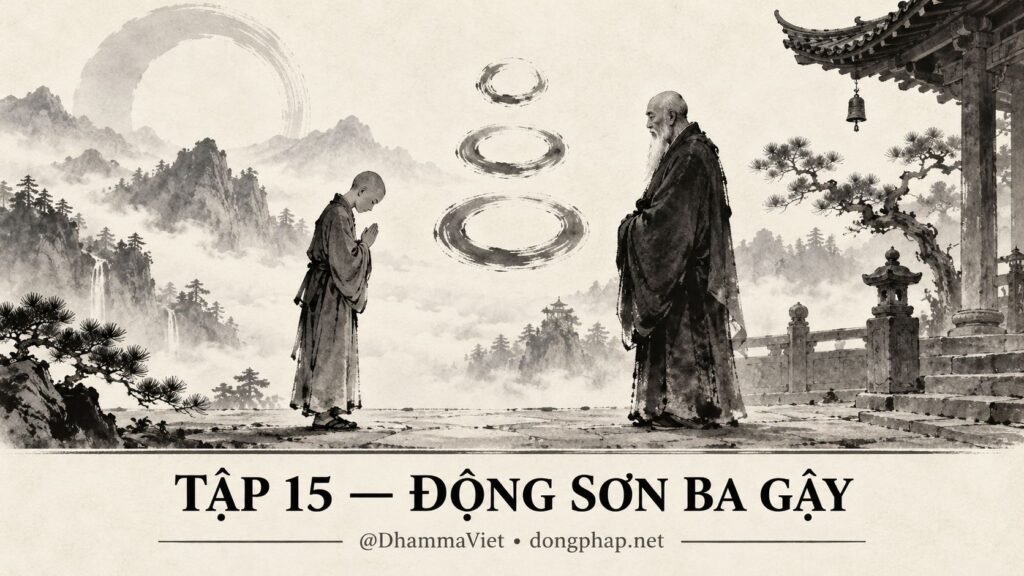
Dongshan’s Three Blows: When a Correct Answer Is Still Not Enough for Awakening
Reading the koan Dongshan’s Three Blows (洞山三頓) alongside intention, clinging to views, virtue and the art of teaching in the Pāli Canon.

Dongshan’s Three Blows shows that answering with correct information is not necessarily wisdom. Dongshan reported his journey clearly, yet Yunmen still declared that he was sparing him three blows, questioning his endless searching. The text only records the declaration; it does not describe an actual beating. Even so, the koan cannot serve as grounds for striking anyone. Compared with the Nikāyas: observe intention (AN 6.63), speak what is true, beneficial and timely (MN 58), and recognise subtle conceit (SN 22.89). This is a comparison, not an identification of the two traditions.
Welcome, dear listeners of the Dòng Pháp Podcast. Today we introduce the fifteenth koan in the Gateless Gate (Wumenguan) of Chan master Wumen Huikai, called Dongshan’s Three Blows — a story that makes students of the Dhamma reflect on the difference between answering a question correctly and truly understanding what is being asked.
In particular, today’s koan raises an issue that cannot be taken lightly: can beating ever be regarded as a method of teaching?
The story goes that a monk named Dongshan came to consult the Chan master Yunmen.
Yunmen asked:
Where have you come from?
Dongshan replied:
From Chadu.
Yunmen asked:
Where did you spend the past summer?
Dongshan replied:
At Baoci Monastery, in Hunan.
Yunmen asked:
When did you leave there?
Dongshan replied:
On the twenty-fifth day of the eighth month.
Yunmen said:
I spare you three blows!
The next day, Dongshan came back and asked:
Yesterday, Venerable, you spared me three blows, but I don’t know where my fault lies.
Yunmen answered with a rebuke, questioning why Dongshan kept wandering from one place to another.
According to the koan, at that very moment Dongshan was greatly awakened.
Hearing this, many people will probably find it puzzling.
A man is asked where he is from, where he stayed and on what date he left.
He answers very clearly.
He doesn’t give a wrong address.
He doesn’t mix up the calendar.
He doesn’t falsify his itinerary.
And yet he is declared to deserve three blows!
If this were a job interview, the candidate would surely ask:
Excuse me, which part of my CV needs correcting?
But the koan is not simply about giving a wrong answer.
It raises the question: Can a person know exactly where they have been, where they stayed and what they did, and yet not have noticed what is going on in their own mind?
PART 1 Knowing a lot of information is not necessarily wisdom
Dongshan answered Yunmen’s questions accurately.
Where have you come from?
Where did you spend the summer?
When did you leave?
All of this is information that belongs to memory.
A person can remember their travels very clearly.
Know the names of hundreds of temples.
Know many suttas by heart.
Remember every Pāli term.
But remembering does not automatically mean the ending of suffering.
Some people know this line by heart:
Sabbe saṅkhārā aniccā.
All conditioned formations are impermanent.
Yet when their brand-new phone gets a tiny scratch, they instantly suffer as if they had lost a family heirloom.
The mouth says impermanence.
The mind demands a lifetime warranty.
Some people explain non-self beautifully.
But if someone leaves their name off a list of thanks, the mind immediately feels insulted.
Understanding a concept is one step.
Seeing reality with wisdom is another.
In Dhammapada 19–20, the Buddha distinguishes the person who recites many scriptures but does not practise from the person who learns little yet lives according to the Dhamma, abandoning greed, hatred and delusion.
The value of the teaching does not lie only in the ability to explain it.
It lies in inner transformation.
PART 2 Travelling everywhere to seek the Way, yet the mind still carries itself along
In the koan, Yunmen questions Dongshan’s wandering from place to place.
That detail may call to mind a familiar problem: endless searching.
Some people think they must go to a very distant temple to be able to practise.
They must meet a famous teacher.
They must attend a special retreat.
They must find a method no one else knows.
And once they arrive, they hear there is somewhere else even better.
So they set off again.
Some people go from one retreat to the next.
Learn one method after another.
Buy lots of books.
Save hundreds of talks.
Yet they still haven’t really observed greed, hatred and delusion in daily life.
The mind can turn the search for the Dhamma into a subtle form of craving.
However, that does not mean seeking a teacher, studying the Dhamma or attending a retreat is wrong.
In the Nikāyas, associating with good spiritual friends and listening to the true Dhamma are important conditions.
The problem lies in the motive.
Going in order to learn and practise is one thing.
Going because you always believe happiness lies only in the next place is something else.
A person may fly thousands of kilometres in search of peace.
But when the plane is twenty minutes late, they instantly flare up.
Peace hasn’t arrived yet.
Anger has already checked in for the flight.
PART 3 Cetanā — intention is what needs observing
In Pāli, cetanā is intention.
In AN 6.63, the Nibbedhika Sutta, the Buddha teaches:
Cetanāhaṃ, bhikkhave, kammaṃ vadāmi.
Intention, bhikkhus, is what I call kamma.
This helps broaden how we look at actions.
Two people go to the same meditation centre.
One wants to learn how to recognise craving and aversion.
The other wants a special experience to tell their friends about.
They sit in meditation together.
Listen to Dhamma talks together.
Eat in silence together.
But their motives may be very different.
One person gives out of generosity.
Another gives because they want their name on the donors’ board.
The outward action is the same.
But the quality of intention is different.
Still, intention is no excuse for ignoring consequences.
Someone who claims good intentions but causes harm still needs to examine, and take responsibility for, that action.
In practice, we need to observe motive, method and result alike.
The mind can turn the search for the Dhamma into a subtle form of craving.
PART 4 Three blows — a legitimate means of teaching?
This is a point that needs to be made clear.
In the koan, Yunmen says he is sparing Dongshan three blows.
The text records a declaration; it does not describe those three blows actually being delivered.
So the koan should not be retold as if Dongshan were certainly struck three times.
But whether it is a threat or a symbolic way of speaking, the image of three blows still raises an ethical question.
In the Pāli Canon, teaching must be grounded in virtue and harmlessness.
A koan cannot be used as grounds for encouraging the beating of students.
In MN 58, the Abhayarājakumāra Sutta, the Buddha sets out the principle of speaking what is true, beneficial and timely.
A statement may not be pleasant to hear.
But it must be genuinely beneficial.
And it must be spoken with an understanding of the right circumstances.
That does not mean one has the right to insult, threaten or mistreat others.
A teacher can be strict.
Can ask hard questions.
Can point out mistakes.
But strictness does not automatically permit violence.
If a teacher says:
I hit my students to break their attachments!
Parents have every right to reply:
Please break attachments with a method that doesn’t cause injuries.
This is not opposing wisdom.
It is protecting the principle of harmlessness.
PART 5 Right speech is not always pleasant to hear
In Pāli, sammāvācā is right speech.
Right speech includes refraining from false speech, divisive speech, harsh speech and idle chatter.
But right speech does not mean only saying things that make others happy.
Sometimes the truth is hard to hear.
A doctor has to inform a patient of a serious illness.
A teacher has to point out errors.
A friend has to stop a dangerous action.
What matters is that the words are true, beneficial and suited to the situation.
In MN 58, the Buddha does not take pleasantness as the sole standard for speech.
He considers truthfulness, benefit and timing.
So stern feedback can be appropriate if it is given in the right way.
But hurtful words spoken out of anger do not become right speech just because the speaker claims to be teaching.
Someone may say:
I’m just being frank!
But if the feedback is mainly meant to humiliate others, the motive needs re-examining.
Frankness is not a licence for harshness.
Truthfulness is no excuse for lacking compassion.
PART 6 When the self wants to be recognised as someone who understands the Way
There is a very subtle form of clinging.
It is the wish to be recognised as someone who has understood.
A person studies many scriptures.
Attends many retreats.
Meets many teachers.
And gradually an image forms:
I am someone with deep understanding.
When someone asks a difficult question, the mind immediately feels challenged.
It is no longer simply seeking the truth.
It becomes defending a reputation.
In Pāli, māna is conceit.
A subtle form is asmimāna, the sense “I am”.
In SN 22.89, the Khemaka Sutta, an explanation is recorded of how the sense “I am” can persist even after coarser forms of self-view have been abandoned.
This shows that conceit can be very subtle.
A person may no longer want to own many possessions.
But still want to own the title of an awakened one.
No longer want to top the business rankings.
But want to top the rankings of people who have let go of the ego.
And if no one recognises it, they immediately feel treated unfairly.
The ego is sometimes very creative.
When it can no longer wear the suit of a successful businessperson, it can put on the robe of a humble practitioner.
But it still wants to be seen by everyone.
PART 7 Awakening is not a secret answer
In many Chan koans, students often look for a special answer.
A phrase beyond logic.
An unexpected gesture.
A shout.
A silence.
But if one merely imitates those forms, it is easy to turn the koan into a guessing game.
Someone asks:
What is Buddha?
The other shouts loudly.
Someone asks:
Where is the Way?
The other holds up a sandal.
Someone asks:
How does suffering end?
The other bangs the table.
Without real understanding, such actions are only copying.
In the Nikāyas, the Buddha presents the path to liberation through the Four Noble Truths and the Noble Eightfold Path.
In SN 56.11, he clearly sets out suffering, the cause of suffering, the cessation of suffering and the path leading to the cessation of suffering.
Awakening is not determined by correctly guessing a secret answer.
But by realising reality and ending the causes of suffering.
A person may answer brilliantly about impermanence.
But if they are still strongly driven by craving, the practice still needs to continue.
Another person may say very little.
Yet know how to recognise greed, hatred and delusion, and develop virtue, concentration and wisdom.
That is a direction with a clear foundation in the Nikāyas.
PART 8 Practice: how does the mind react when questioned?
Try observing a situation in which someone asks you a question or gives you feedback.
It might be at work.
In the family.
In a discussion.
Or while studying the Dhamma.
First, recognise the feeling.
Is there discomfort?
Embarrassment?
Anger?
Worry that others will judge you?
Next, observe the intention.
Do you want to understand the issue?
Or to prove you are right?
Do you want to learn?
Or to protect your self-image?
Then observe your speech.
Are you actually answering the question?
Or switching to attacking the questioner?
Can you admit that you don’t know?
Can you say:
This needs looking into further.
A very simple sentence.
But sometimes harder than memorising a long sutta.
Because it requires humility.
And the ability not to identify your self-worth with always having an answer.
PART 9 When the student is no longer afraid of not yet understanding
Back to the koan of Dongshan’s Three Blows.
Dongshan answers questions about his journey.
Yunmen declares that he spares him three blows.
Dongshan comes back to ask why.
After the next challenge, the koan says Dongshan was greatly awakened.
From this story we cannot determine Dongshan’s exact state of realisation in terms of the system of noble fruits in the Nikāyas.
Nor should we claim that the rebuke or the image of three blows by itself produced awakening.
But the koan can suggest something worth reflecting on.
A person may know very well which places they have passed through.
But not necessarily know how craving is steering that journey.
They may remember a great many sutta passages.
But not necessarily recognise conceit when questioned.
They may seek out a great many teachers.
But not necessarily practise what they have learned.
And they may answer every theoretical question correctly.
Yet still need to keep observing the mind’s reactions in daily life.
Wisdom is not just knowing the answer. Wisdom is also the ability to see clearly what is arising in the mind, to understand the cause of suffering and to practise the path leading to the ending of suffering.
A sincere practitioner does not need to always appear to have understood.
They can admit what they don’t know.
They can accept appropriate feedback.
They can refuse methods that cause harm.
They can learn without losing the ability to think things through.
And, more importantly, they can keep practising without turning practice into a contest for the title of awakened one.
For liberation is not a prize for whoever answers fastest.
Nor is it a certificate for whoever has visited the most meditation centres.
It is the ending of greed, hatred and delusion through the path of virtue, concentration and wisdom.
PART 10 Which three blows are most worth reflecting on?
Perhaps, on hearing this koan, what is most worth reflecting on is not how to avoid Yunmen’s three blows.
But recognising three very familiar kinds of clinging.
Clinging to knowledge.
Clinging to the image of a practitioner.
And clinging to the wish to always be recognised as right.
These three kinds of clinging can make a student very tired.
Knowing a lot but not daring to admit what they don’t know.
Practising for a long time but afraid others will see they still have anger.
Talking about non-self but always needing to defend the ego.
When these tendencies are recognised, the practitioner has the chance to develop humility and wisdom.
No one needs to deliver three blows.
No need to create shocking situations.
No need to turn practice into a test of power.
All it takes is mindfulness to recognise.
Virtue so as not to cause harm.
Wisdom to distinguish wholesome from unwholesome.
And perseverance to keep practising.
That is a path that is clear, practical and in keeping with the spirit of the Pāli Canon.
2. Observe the intention behind your answer. Ask yourself whether you want to understand the issue or prove you are right, to learn or to protect your self-image.
3. Practise saying “I don’t know yet”. When something is unclear, try saying “This needs looking into further” and observe the humility in the mind.
• Memorising many scriptures and terms does not automatically mean the ending of suffering (Dhammapada 19–20).
• The same outward action can carry very different qualities of intention (AN 6.63).
• The text only records the declaration of sparing three blows; teaching must rest on harmlessness and on speech that is true, beneficial and timely (MN 58).
• Subtle conceit can remain even when coarse self-view has been abandoned; awakening is realising the Four Noble Truths (SN 22.89, SN 56.11).
- Am I seeking teachers and retreats because I want to practise, or because I believe happiness lies in the next place?
- When I receive feedback, do I answer the real question or switch to attacking the questioner?
- Do I want to be recognised as someone who understands the Way?
Why did Dongshan “deserve” three blows even though he answered correctly?
Dongshan answered accurately where he had come from, where he spent the summer and when he left, yet Yunmen still declared that he was sparing him three blows, and afterwards questioned his wandering from place to place. The koan suggests that knowing your outer journey well does not necessarily mean you have noticed what is happening in your mind.
Was Dongshan actually struck three times?
The text only says Yunmen spared him three blows; it does not describe an actual beating. So the story should not be told as if Dongshan were certainly struck. Whether a threat or a symbolic expression, the image still raises an ethical question, and the koan cannot be used to encourage beating students.
Does right speech mean only saying pleasant things?
No. In MN 58 the Buddha considers the truthfulness, benefit and timing of speech, not taking pleasantness as the only standard. Stern feedback can be appropriate if given rightly, but hurtful words spoken from anger do not become right speech just because the speaker claims to be teaching.
Scriptures compared: Dhammapada 19–20; AN 6.63 — Nibbedhika Sutta; MN 58 — Abhayarājakumāra Sutta; SN 22.89 — Khemaka Sutta; SN 56.11 — Dhammacakkappavattana Sutta. Original koan: The Gateless Gate, case 15 — Dongshan’s Three Blows 洞山三頓. In the koan text, Yunmen declares that he spares three blows; it does not narrate three blows actually being given. The analyses of intention, clinging and teaching methods are a line of comparison following the Nikāyas, not the only solution to this Chan koan.
In the next episode, the Dòng Pháp Podcast explores the sixteenth koan: The Bell and the Seven-Piece Robe — When you hear a sound, where has the mind already gone?
A question from Yunmen about the sound of the bell and putting on the robe will open a comparison with phassa, contact; vedanā, feeling; saññā, perception; and viññāṇa, consciousness.
When the ear hears the bell, what really happens?
Is there only sound?
Or, right after it, has the mind already created a whole series of thoughts, memories and stories about itself?
Thank you for listening. If you enjoyed it, please leave a comment, subscribe, like and share it with those who may benefit. See you in the next episode of the Dòng Pháp Podcast.
There are 33 more episodes in the series The Gateless Gate in the Light of the Pāli Canon — follow the Dòng Pháp Podcast at dongphap.net to walk the whole journey.
Series The Gateless Gate in the Light of the Pāli Canon — 48 episodes comparing Chan koans with the Pāli Canon: comparing in order to understand, without merging the two traditions. More translated articles:
- What Is Theravāda Buddhism? A Complete Guide
- Namo Tassa Bhagavato Arahato Sammāsambuddhassa: Discovering Its Sacred Meaning
- Episode 1: What Is the Sūtra of Immeasurable Life? Why Read It in the Light of the Pāli Canon?
- What Is the Pāli Canon (Tipiṭaka)? A Complete Guide
- Where Does Language Reach Its Limit?
Read all 48 episodes in order
See the full series →Translated from the Vietnamese original: Tập 15: Động Sơn ba gậy – Khi câu trả lời đúng vẫn không đủ để giác ngộ


