
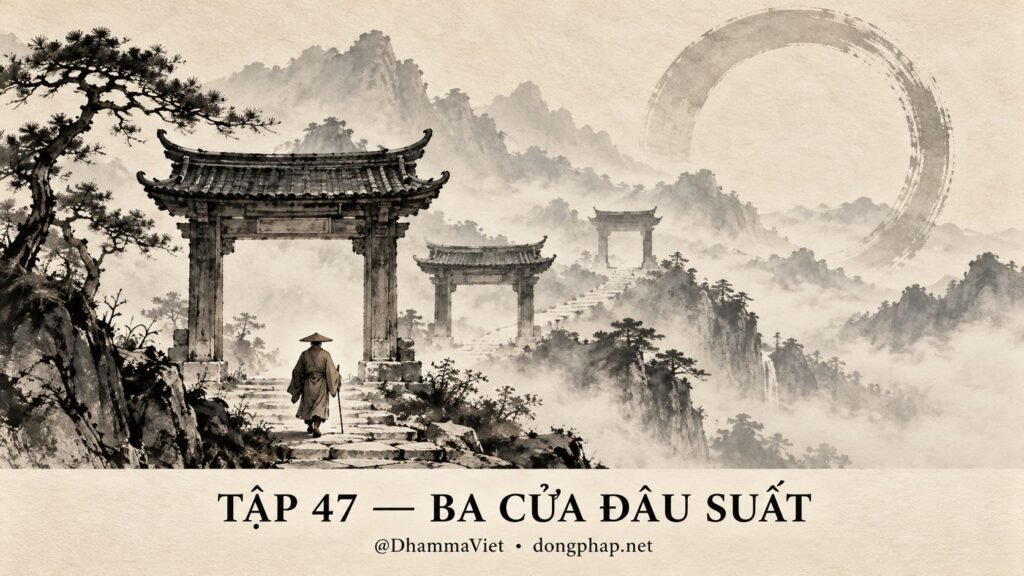
Doushuai’s Three Barriers: Seeing One’s Nature, Escaping Birth and Death, Then Going Where?
Reading the koan Doushuai’s Three Barriers (兜率三關) alongside yoniso manasikāra, anattā, paṭiccasamuppāda and the path to the ending of suffering in the Pāli Canon.

Doushuai’s Three Barriers are three questions from Chan master Doushuai Congyue: where is your own nature, how do you escape when you die, and where do you go when the four elements separate? Compared with the Pāli Canon, the five aggregates are not self (SN 22.59), birth and death are set out within dependent origination (SN 12.2), and the Tathāgata after death cannot be described with the categories of existing or not existing (MN 72). Liberation is not finding an unchanging self, but ending ignorance, craving and clinging.
Welcome, dear listeners of the Dòng Pháp Podcast. Today we introduce the forty-seventh koan in the Gateless Gate (Wumenguan) of Chan master Wumen Huikai, called Doushuai’s Three Barriers.
Imagine someone arriving at the gate of a temple.
On the gate are three questions.
The first: You seek your own nature — so where is your own nature?
The second: If you see your own nature you escape birth and death — so when death comes, how do you escape?
The third: If you escape birth and death — then where do you go?
At first hearing, it sounds like an admissions interview.
Round one tests knowledge.
Round two tests the ability to apply it.
Round three tests your future direction.
If this were a company, the HR department might announce:
Candidates must pass three rounds.
No multiple-choice questions.
No model answers.
No notes allowed.
No asking artificial intelligence to answer for you.
And above all, no answering with a sentence that sounds very profound while you have no idea what you are saying.
These three questions are not meant to trick the student.
They raise the core issues of self, birth and death, and liberation.
When we speak of seeing one’s nature, what is actually seen? When we speak of escaping birth and death, what is ended? And when we ask where one goes, is that question assuming a permanent self?
PART 1 The koan: Chan master Doushuai’s three barriers
In the Gateless Gate, the forty-seventh koan records three questions from Chan master Doushuai Congyue.
The first question:
撥草參玄只圖見性,即今上人性在甚處。
You part the grass and seek the profound only in the hope of seeing your nature. So right now, venerable one, where is your nature?
The second question:
識得自性方脫生死,眼光落地時作麼生脫。
Only by recognising your own nature do you escape birth and death. When the light of your eyes falls to the ground — that is, when life ends — how do you escape?
The third question:
脫得生死便知去處,四大分離向甚處去。
If you escape birth and death, you know where you are going. When the four elements separate, where do you go?
These three questions are called the three barriers.
In the Chan tradition, they may be used to test understanding and the experience of practice.
But we must clearly distinguish: this is a koan from Chan literature, not a Pāli sutta.
In particular, the Chan term “own nature” should not be simplistically identified with an unchanging soul.
PART 2 The first barrier: where is your own nature?
The first question is:
You seek your own nature.
So where is your own nature?
In daily life, people often want to find their true essence.
A hidden self.
An original person.
An unchanging ego.
Some think:
If I can find my true self, every problem will be solved.
But in the Pāli Canon, the Buddha teaches us to contemplate the five aggregates.
Rūpa — form.
Vedanā — feeling.
Saññā — perception.
Saṅkhārā — volitional formations.
Viññāṇa — consciousness.
In SN 22.59, the Anattalakkhaṇa Sutta, he teaches that the five aggregates are not self.
Netaṃ mama, nesohamasmi, na meso attā.
This is not mine, this I am not, this is not my self.
This does not mean denying all experience.
It means not regarding the phenomena of body and mind as a permanent self.
PART 3 When we look for the self like a lost object
Someone loses their keys.
They can look in their pocket.
In the drawer.
On the table.
In the car.
Someone loses their phone.
They can ring the number to find it.
But when we ask where the real “I” is located, the problem is not so simple.
If you look in the body, the body changes.
If you look in emotions, emotions change.
If you look in thoughts, thoughts change.
If you look in memories, memories can change too.
If you look in consciousness, consciousness arises dependent on conditions.
Someone will say:
Then you have to look deeper.
But how deep?
If there were a self-finder app, the screen might display:
Scanning the five aggregates.
No unchanging entity detected.
Please check your initial assumption.
This is where the teaching of non-self becomes important.
Not to create yet another mystery.
But to observe what is actually arising and changing.
Liberation is not finding an unchanging self to protect from birth and death.
PART 4 Yoniso manasikāra — wise attention
In Pāli, yoniso manasikāra is wise attention.
In MN 2, the Sabbāsava Sutta, the Buddha distinguishes wise attention from unwise attention.
Unwise attention can lead to questions that make wrong views grow.
For example, speculations about the self in the past, present and future.
Wise attention, by contrast, is directed toward recognising suffering.
The cause of suffering.
The ending of suffering.
The path leading to the ending of suffering.
This is a very important point.
Not every philosophical question has the same liberating value.
Some questions make the mind clear.
Some questions keep the mind proliferating.
Some questions help us recognise craving.
Some questions only increase our clinging to views.
So when facing the question “where is your own nature?”, we need to examine whether that way of searching helps end suffering or not.
PART 5 The second barrier: when death comes, how do you escape?
Doushuai’s second question is very direct.
If you have recognised your own nature and escaped birth and death, then when life ends, how do you escape?
This is a question about birth and death.
In Pāli, jāti is birth.
Jarā is ageing.
Maraṇa is death.
In SN 12.2, the Vibhaṅga Sutta, the Buddha sets out the links of dependent origination.
Avijjāpaccayā saṅkhārā.
With ignorance as condition, volitional formations arise.
And within the chain of dependent origination:
Bhavapaccayā jāti.
With becoming as condition, birth arises.
Jātipaccayā jarāmaraṇaṃ.
With birth as condition, ageing and death arise.
This shows that birth and death are presented within the relationships of dependent origination.
Not as an event entirely separate from other conditions.
PART 6 Escaping birth and death is not a technique for dodging death
Some people hear about liberation from birth and death and think:
So an awakened person won’t die?
But in Buddhist history, the Buddha still underwent the ending of bodily life.
In DN 16, the Mahāparinibbāna Sutta, the Buddha’s entry into Parinibbāna is recorded.
So liberation should not be understood as making the present body physically immortal.
In the Nikāyas, liberation concerns the ending of ignorance, craving and the causes that lead to rebirth.
A person may want to avoid ageing.
Avoid illness.
Avoid death.
But the conditioned body is still subject to change.
What needs recognising is not only the fear of death.
But also the craving and clinging that keep suffering arising.
PART 7 The third barrier: when the four elements separate, where do you go?
The third question is:
When the four elements separate, where do you go?
In Pāli, the four great elements are called mahābhūta.
Pathavī-dhātu — the earth element.
Āpo-dhātu — the water element.
Tejo-dhātu — the fire element.
Vāyo-dhātu — the air element.
In MN 28, the Mahāhatthipadopama Sutta, the elements are presented as factors to be contemplated.
The body is not an unchanging entity.
It depends on conditions.
When conditions change, the body changes too.
But the question “where do you go?” may contain an assumption.
That there is a fixed self that leaves the body and travels to some location.
In the Nikāyas, we need to be careful with that assumption.
The teaching of non-self does not support the idea of a permanent, unchanging soul that moves intact from one life to the next.
At the same time, the Buddha did not equate non-self with a simple annihilationist view.
PART 8 When the question “where do you go?” becomes a trap
Someone asks:
After an arahant enters Parinibbāna, where do they go?
Someone else answers:
To a very peaceful place.
Another says:
Nowhere at all.
Yet another says:
Both going and not going.
And then the debate drags on.
In MN 72, the Aggivacchagotta Sutta, the Buddha converses with the wanderer Vacchagotta about questions concerning the Tathāgata after death.
He uses the example of a fire that has gone out when its fuel is exhausted.
The categories of existing, not existing, both existing and not existing, or neither, cannot simply be applied to describe the Tathāgata after death.
This is very important.
Not because the Buddha wanted to create a secret.
But because those categories are not suited to describing liberation from clinging.
PART 9 Practice: three questions for observing body and mind
Try a practice based on three themes.
The first question:
What is being called “I”?
Observe the body.
Feelings.
Thoughts.
Memories.
Intentions.
Recognise that these phenomena change.
The second question:
What is causing suffering to arise?
Observe craving.
Resistance.
Fear.
Holding on.
Recognise the connection between feeling and reaction.
The third question:
What can be let go of right now?
It might be a resentment.
A wish to control.
A stubborn opinion.
A need for recognition.
There is no need to find a mystical answer.
No need to try to imagine realms after death.
Just observe the conditions that are creating suffering in the present.
PART 10 When the three barriers are no longer three riddles
Back to the koan.
Doushuai poses three questions.
Where is your own nature?
When death comes, how do you escape?
When the four elements separate, where do you go?
In the Chan tradition, these three barriers can be understood as tests of understanding and the experience of practice.
But in the light of the Pāli Canon, they should not be turned into three riddles requiring a secret password.
What matters is clearly understanding non-self.
Clearly understanding dependent origination.
Clearly understanding suffering and its cause.
Clearly understanding the path that leads to the ending of suffering.
Liberation is not finding an unchanging self to protect from birth and death. Liberation is the ending of the ignorance, craving and clinging that keep suffering arising.
A person can ask many questions.
But still needs to practise.
Can study many doctrines.
But still needs to know their own mind.
Can think about death.
But still needs to live mindfully.
Can talk about Nibbāna.
But still needs to end greed, hatred and delusion.
There is no need to turn the three barriers into a quiz.
No need to search for a secret self.
No need to imagine liberation as a journey to some destination.
No need to use mystical answers to cover up a lack of understanding.
What is needed is to practise the Noble Eightfold Path.
Right view.
Right intention.
Right speech.
Right action.
Right livelihood.
Right effort.
Right mindfulness.
Right concentration.
And when the mind begins to cling to an answer, recognise that very clinging.
Perhaps the deepest question of Doushuai’s three barriers is not how to answer in order to get through.
But rather:
Facing birth and death, is the mind looking for a self to keep holding on to, or is it developing the wisdom that clearly sees the conditions that need to be ended?
2. What is causing suffering to arise? Observe craving, resistance, fear and holding on, and the connection between feeling and reaction.
3. What can be let go of right now? A resentment, a wish to control, a stubborn opinion or a need for recognition — no need to imagine realms after death.
• Doushuai Congyue sets three barriers: where is your nature, how do you escape when the light of your eyes falls to the ground, and where do you go when the four elements separate.
• Searching for one’s own nature in the five aggregates finds no unchanging entity (SN 22.59); wise attention directs questions toward suffering and its ending (MN 2).
• Birth, ageing and death are set out within the chain of dependent origination (SN 12.2); liberation does not make the body immortal, since the Buddha still entered Parinibbāna (DN 16).
• The question “where do you go?” quietly assumes a travelling self; the Buddha answered Vacchagotta with the image of the fire that has gone out (MN 28, MN 72).
- When I look for my true self, am I looking in the body, emotions, thoughts or memories — and which of these does not change?
- Which of the questions I often ask make my mind clear, and which only keep it proliferating?
- Which craving and clinging present right now is my fear of death tied to?
What are the questions of Doushuai’s Three Barriers?
First: you part the grass and seek the profound only hoping to see your nature — so right now, where is your nature? Second: only by recognising your own nature do you escape birth and death — when the light of your eyes falls to the ground, how do you escape? Third: if you escape birth and death you know where you are going — when the four elements separate, where do you go?
Is “own nature” in Chan an unchanging soul?
It should not be simplistically identified that way. Compared with the Pāli Canon, the Buddha teaches us to contemplate the five aggregates and states in SN 22.59 that they are not self. This does not deny experience; it means not regarding the phenomena of body and mind as a permanent self.
After Parinibbāna, where does an awakened one go?
In MN 72 the Buddha converses with Vacchagotta and uses the example of a fire that has gone out when its fuel is exhausted. The categories of existing, not existing, both, or neither cannot simply be used to describe the Tathāgata after death, because they do not fit liberation.
Scriptures compared: SN 22.59 — Anattalakkhaṇa Sutta; MN 2 — Sabbāsava Sutta; SN 12.2 — Vibhaṅga Sutta; DN 16 — Mahāparinibbāna Sutta; MN 28 — Mahāhatthipadopama Sutta; MN 72 — Aggivacchagotta Sutta; SN 56.11 — Dhammacakkappavattana Sutta. Original koan: The Gateless Gate, case 47 — Doushuai’s Three Barriers 兜率三關. The analyses of non-self, dependent origination, birth and death, and liberation are a line of comparison following the Nikāyas, not the only solution to this Chan koan.
In the next episode, the Dòng Pháp Podcast explores the forty-eighth koan, the last koan of the Gateless Gate: Qianfeng’s One Road — When all the Buddhas walk a single road, where is that road?
A question about the road to awakening will open a comparison with ariya aṭṭhaṅgika magga, the Noble Eightfold Path; dukkhanirodha, the ending of suffering; and the meaning of the path of practice in the Pāli Canon.
Is the path to liberation a place to be reached?
Or a process of practice to be carried out right within daily life?
Thank you for listening. If you enjoyed it, please leave a comment, subscribe, like and share it with those who may benefit. See you in the next episode of the Dòng Pháp Podcast.
There is 1 more episode in the series The Gateless Gate in the Light of the Pāli Canon — follow the Dòng Pháp Podcast at dongphap.net to walk the whole journey.
Series The Gateless Gate in the Light of the Pāli Canon — 48 episodes comparing Chan koans with the Pāli Canon: comparing in order to understand, without merging the two traditions. More translated articles:
- What Is Theravāda Buddhism? A Complete Guide
- Namo Tassa Bhagavato Arahato Sammāsambuddhassa: Discovering Its Sacred Meaning
- Episode 1: What Is the Sūtra of Immeasurable Life? Why Read It in the Light of the Pāli Canon?
- What Is the Pāli Canon (Tipiṭaka)? A Complete Guide
- Where Does Language Reach Its Limit?
Read all 48 episodes in order
See the full series →Translated from the Vietnamese original: Tập 47: Ba cửa Đâu Suất – Thấy tánh, thoát sinh tử, rồi đi về đâu?


