
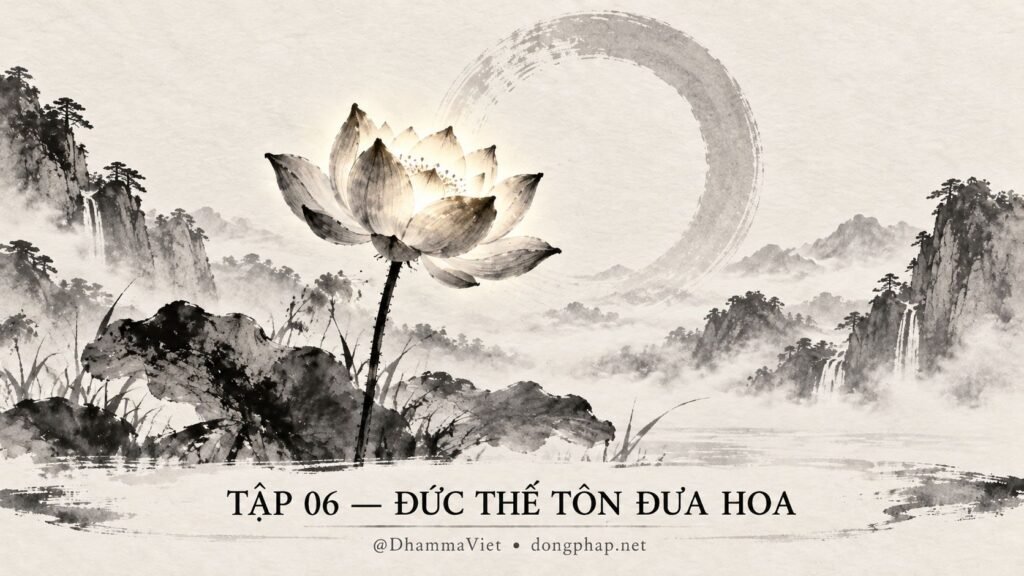
The World-Honored One holds up a flower: can a smile transmit awakening?
Comparing the koan “The World-Honored One Holds Up a Flower” 世尊拈花 with direct insight, dependent origination, the realization of Mahākassapa and the path of liberation in the Nikāyas.

The World-Honored One holds up a flower is the story of the Buddha raising a flower, Mahākassapa smiling, and being entrusted with the Treasury of the True Dharma Eye. The story belongs to East Asian Chan/Zen literature and is not recorded in this form in the four Nikāyas. Read against the Pāli Canon, liberation cannot be handed over like an object: the Tathāgatas only point the way, the student must make the effort (Dhammapada 276), and wisdom develops through a process of listening, reflecting and practising up to personal realization (MN 70).
Greetings to everyone listening to Dòng Pháp Podcast. Today’s episode introduces the sixth koan of the Gateless Gate by Chan master Wumen Huikai, called “The World-Honored One Holds Up a Flower” — a story so famous that the mere mention of a flower and a smile makes many people think at once of the Chan transmission of the mind-seal.
The story tells that one day the World-Honored One was on Vulture Peak, and before the great assembly he held up a flower.
Everyone was silent.
Only the Venerable Mahākassapa smiled.
The World-Honored One then declared that he possessed the Treasury of the True Dharma Eye, the wondrous mind of Nirvāṇa, the true form that is formless, the subtle Dharma gate, not founded on words and letters, a special transmission outside the scriptures — and that he now entrusted it to Mahākassapa.
A flower.
A smile.
A transmission.
No three-hour lecture.
No whiteboard.
No note-taking.
If this story took place in a modern classroom, someone would probably raise a hand at the end and ask:
Teacher, is there a PDF handout for today’s transmission?
But the question worth pondering is this: a smile may express understanding, but can it replace the entire path of practice?
And more importantly, does this story appear in the Pāli Canon at all?
PART 1 The flower in Chan and Mahākassapa in the Nikāyas
First of all, we need to distinguish history from religious tradition.
The koan of the World-Honored One holding up a flower belongs to East Asian Chan/Zen literature. The story is not recorded in the four Nikāyas in the form of the Buddha holding up a flower and transmitting the mind-seal to Mahākassapa.
So it should not be presented as a historical event confirmed by the Pāli Canon.
Nevertheless, the Venerable Mahākassapa is a figure with a special place in early Buddhist tradition.
In AN 1, the Buddha praises him as foremost among the bhikkhus who practise the austere ascetic observances (dhutaṅga).
Mahākassapa was renowned for his simple life, his few needs, his love of seclusion and his strict observance of the holy life.
In SN 16.5, the Jiṇṇa Sutta, the Buddha advises Mahākassapa, now advanced in years, to accept more comfortable living conditions.
But Mahākassapa explains his reasons for continuing his simple, austere way of life: for his own benefit and as an example for later generations.
This shows that the image of Mahākassapa in the Nikāyas is not tied to a single special moment.
It is the image of an elder who went through a long and profound process of practice.
If one looks only at the smile in the koan and forgets Mahākassapa’s whole life of holy conduct, the student may misread the essential point.
It is like watching an athlete win a gold medal and concluding that the secret of success lies in the gesture of raising a hand on the podium.
That gesture is beautiful.
But behind it lie many years of training.
PART 2 Direct insight does not mean there is no need to learn
One of the striking features of Chan is its emphasis on direct insight.
In this tradition, the formula “not founded on words and letters” is often used to point out that the truth of liberation cannot be wholly confined within language and concepts.
But to take this as meaning there is no need to study the suttas, no need to keep the precepts, no need to practise — that is a very dangerous leap.
In the Pāli Canon, the Buddha constantly teaches by means of language.
He analyses the Four Noble Truths.
He expounds the Noble Eightfold Path.
He gives instructions in meditation.
He explains dependent origination.
He points out clearly the hindrances and the conditions that lead to liberation.
In MN 70, the Kīṭāgiri Sutta, the Buddha describes the process of learning and practice: from faith, to approaching a good teacher, listening, remembering, examining the meaning, accepting after reflection, giving rise to desire, making effort, and finally realizing for oneself.
This shows that wisdom is not merely the result of hearing a secret phrase.
A person may hear a very short teaching and give rise to profound understanding.
But that understanding does not necessarily appear out of nowhere.
It may rest on conditions accumulated through learning and practice.
PART 3 Is a smile awakening?
A smile is an outward expression.
But an outward expression is not enough to determine the whole state of the mind.
One person smiles out of joy.
One person smiles out of politeness.
One person smiles because they have just understood something.
Another smiles because they don’t want to explain that they haven’t understood anything.
In a meeting, when the manager asks:
Does everyone understand the plan?
The whole room smiles and nods.
But when the work begins, everyone does it a different way.
The smiles were perfectly uniform.
The understanding, not necessarily.
In the Pāli Canon, realization is described through profound transformations of perception and the cutting off of the fetters.
In SN 56.11, when the Venerable Koṇḍañña gains the Dhamma eye, the sutta records:
Yaṃ kiñci samudayadhammaṃ, sabbaṃ taṃ nirodhadhammaṃ.
Whatever is subject to arising, all that is subject to cessation.
This is seeing and knowing the arising-and-passing nature of phenomena.
Not just a pleasant feeling.
Not just a reaction of surprise.
Still less a facial expression.
So when reading the koan of the World-Honored One holding up a flower, one may regard Mahākassapa’s smile as a symbol of mutual understanding within the Chan tradition.
But one should not conclude that every smile in a spiritual setting proves awakening.
Someone who truly understands non-self can protect their self-image a little less.
PART 4 Can the Dhamma be handed over like an object?
A person can pass a book on to another.
They can pass on a trade.
They can pass on knowledge.
They can hand down experience.
But can liberation be handed over like a key?
In Dhammapada 276, the Buddha teaches:
Tumhehi kiccamātappaṃ, akkhātāro tathāgatā.
You yourselves must make the effort; the Tathāgatas only point the way.
This is an important teaching.
The Buddha points out the path.
The student has to practise.
No one can cut off another’s craving with a mere declaration.
No one can give Nibbāna the way one gives a birthday present.
If liberation could be transferred like a bank payment, humanity would probably already have services like:
The basic awakening package.
The advanced awakening package.
The lifetime awakening package, with a no-rebirth warranty.
But the path the Buddha taught does not work like that.
Virtue must be practised.
Concentration must be developed.
Wisdom must be cultivated.
And the ending of suffering must be realized for oneself.
A teacher can give very profound guidance.
A teaching can create a turning point.
An encounter can become an important condition.
But a supporting condition is not the same as replacing the entire process of practice.
PART 5 Seeing a flower can become a practice of mindfulness
Try to imagine a flower placed in front of you.
The eye perceives colour.
The mind recognizes shape.
A pleasant feeling may arise.
The thought may arise that the flower is beautiful.
Then the mind starts naming things.
What variety is this flower?
Who grew it?
How much does it cost?
Should I buy a pot of it for the living room?
From a single flower, the mind can instantly launch an interior-decorating project.
But in Udāna 1.10, the Bāhiya Sutta, the Buddha teaches:
Diṭṭhe diṭṭhamattaṃ bhavissati.
In the seen, there will be only the seen.
This is an instruction not to add to experience an identification with a self and clinging.
When looking at a flower, the practitioner can recognize colour and shape.
Recognize the pleasant feeling.
Recognize the wish to possess.
Recognize the changing of mental states.
There is no need to turn the flower into a sacred object.
No need to search for a secret message in every petal.
It is enough to observe the phenomena that are actually arising.
This is a way of practising in the spirit of the Nikāyas, not the only historical explanation of the flower koan.
PART 6 Impermanence lies right within a flower
A freshly opened flower can be very beautiful.
But that beauty does not last.
The petals will change.
The colour will fade.
The fragrance will lessen.
In the end, the flower will wither.
In Pāli, anicca means impermanence.
The Buddha taught that conditioned phenomena arise due to conditions and are subject to change.
In Dhammapada 277, he teaches:
Sabbe saṅkhārā aniccā.
All formations are impermanent.
When this is seen with wisdom, the practitioner gradually becomes disenchanted with suffering and moves toward the path of purification.
But impermanence is not only in the flower.
The joy of looking at the flower is also impermanent.
The thought of its beauty is also impermanent.
The delight is also impermanent.
Even the feeling of pride at having understood impermanence is impermanent.
Someone can watch a flower wither and say:
Life is impermanent!
But when their newly bought phone gets a tiny scratch, they instantly suffer as if they had just lost the whole of spring.
Understanding impermanence in words is very easy.
Seeing impermanence right within one’s own clinging is the deep practice.
PART 7 Mahākassapa and the lesson of a simple life
In the Nikāyas, Mahākassapa does not stand out for mysterious declarations.
He is known for a life of few wishes, contentment and seclusion.
This is worth pondering.
People often want special spiritual experiences.
They want to see light.
They want to hear strange sounds.
They want a moment that changes the whole world.
Yet they do not want to give up very ordinary habits such as greed, anger and envy.
They want awakening.
But they don’t want anyone to give them feedback.
They want to let go.
But they don’t want to lose their privileges.
They want to live simply.
But every month they still need to buy a few more items to perfect their minimalist style.
So minimalist that they need three wardrobes to hold their minimalist things.
Mahākassapa’s life in the Nikāyas reminds us that liberation is bound up with persistent practice, not just with impressive moments.
Appicchatā is fewness of wishes.
Santuṭṭhi is contentment.
Viveka is seclusion.
These qualities can be nurtured right in everyday life.
One unnecessary need fewer.
One argument born of conceit fewer.
One angry reaction fewer.
One clinging to reputation fewer.
These are small steps, but they have real, practical meaning.
PART 8 A flower, a smile, and the path of realizing for oneself
Back to the koan.
The World-Honored One holds up a flower.
Mahākassapa smiles.
In the Chan tradition, the story symbolizes a transmission beyond language.
In the Pāli Canon, there is no corresponding record of such a transmission of the mind-seal.
But when we compare the two traditions, a profound question appears:
What truly constitutes understanding?
Is it the number of words?
Is it outward form?
Is it a teacher’s recognition?
Or is it the transformation of the mind through right view, practice and wisdom?
A person can be handed a flower.
But no one can hand over, in another’s place, the seeing and knowing of impermanence.
A person can be shown the path.
But no one can take each step for them.
A person can hear very profound teachings.
But no one can cut off greed, hatred and delusion on their behalf.
And perhaps the greatest value of the flower story lies not in trying to imitate Mahākassapa’s smile.
But in realizing that true understanding does not need to be put on display.
Someone who truly understands impermanence can live with less clinging.
Someone who truly understands non-self can protect their self-image a little less.
Someone who truly understands dependent origination can blame less and learn to observe conditions.
Someone who truly develops compassion can hurt others less.
These are signs of practice more worth attending to than an enigmatic smile.
A flower can be passed from one hand to another. But the wisdom of liberation must be developed and realized within the practitioner’s own mind.
2. See impermanence in yourself. Notice that not only the flower, but also the joy, the delight and even the pride at having understood impermanence are all impermanent.
3. One thing less. During the day, drop one unnecessary need, one argument born of conceit or one angry reaction, to nurture fewness of wishes, contentment and seclusion.
• The flower story belongs to East Asian Chan/Zen literature, and there is no corresponding record of a transmission of the mind-seal in the four Nikāyas.
• In the Nikāyas, Mahākassapa is foremost in the austere observances (AN 1) and keeps a simple life as an example for later generations (SN 16.5).
• Wisdom develops through a process from faith, listening and reflection to realizing for oneself (MN 70); the Tathāgatas only point the way (Dhammapada 276).
• A smile is not enough to prove awakening; the Dhamma eye is seeing the arising-and-passing nature of phenomena (SN 56.11), and impermanence shows itself right within a flower (Dhammapada 277).
- What truly constitutes understanding: words, outward form, or the transformation of the mind?
- What special moment am I hoping for in place of persistent daily practice?
- Today, which clinging shows that I have so far understood impermanence only in words?
Is the story of the World-Honored One holding up a flower in the Pāli Canon?
No. The koan belongs to East Asian Chan/Zen literature. The story is not recorded in the four Nikāyas in the form of the Buddha holding up a flower and transmitting the mind-seal to Mahākassapa, so it should not be presented as a historical event confirmed by the Pāli Canon. Even so, Mahākassapa is a figure with a special place in early Buddhism.
How is the Venerable Mahākassapa described in the Nikāyas?
In AN 1, he is praised as foremost among the bhikkhus who practise the austere observances. In SN 16.5, when the Buddha advises him to accept more comfortable conditions in old age, he keeps his simple life for his own benefit and as an example for later generations. That image is bound up with fewness of wishes, contentment and seclusion.
Can awakening be transmitted from teacher to student?
According to the Pāli Canon, a teacher can guide and a teaching can create a turning point, but supporting conditions do not replace the entire process of practice. Dhammapada 276 teaches that you yourselves must make the effort; the Tathāgatas only point the way. No one can cut off greed, hatred and delusion on another’s behalf.
Canonical references: AN 1 — the chapters on the foremost bhikkhus; SN 16.5 — Jiṇṇa Sutta; MN 70 — Kīṭāgiri Sutta; SN 56.11 — Dhammacakkappavattana Sutta; Dhammapada 276–277; Udāna 1.10 — Bāhiya Sutta. Original koan: the Gateless Gate, Case 6 — “The World-Honored One Holds Up a Flower” 世尊拈花. The story of the mind-seal transmission belongs to the East Asian Chan/Zen tradition and is not recorded in this form in the Nikāyas.
In the next episode, Dòng Pháp Podcast will explore the seventh koan: Zhaozhou Washes the Bowl — Is awakening found in washing a bowl?
A monk newly arrived at the monastery asks Chan master Zhaozhou about the path of practice. Zhaozhou only asks whether he has eaten his rice gruel, then tells him to go and wash his bowl.
A simple answer that opens a profound question about mindfulness in everyday life.
In the light of the Pāli Canon, the next episode will compare this koan with sati, sampajañña and clear awareness in the four postures.
Thank you for listening. If you found this helpful, please leave a comment, subscribe to the channel, like, and share it with those who have the affinity. See you in the next episode of Dòng Pháp Podcast.
There are 42 more episodes in the series The Gateless Gate in the Light of the Pāli Canon — follow Dòng Pháp Podcast at dongphap.net to walk the whole journey with us.
Translated from the Vietnamese original: Tập 06: Đức Thế Tôn đưa hoa – Một nụ cười có thể truyền trao giác ngộ?
Series The Gateless Gate in the Light of the Pāli Canon — 48 episodes comparing Chan/Zen koans with the Pāli Canon: comparing in order to understand, not equating the two traditions.
Read all 48 episodes in order in the category
View the whole series →


