
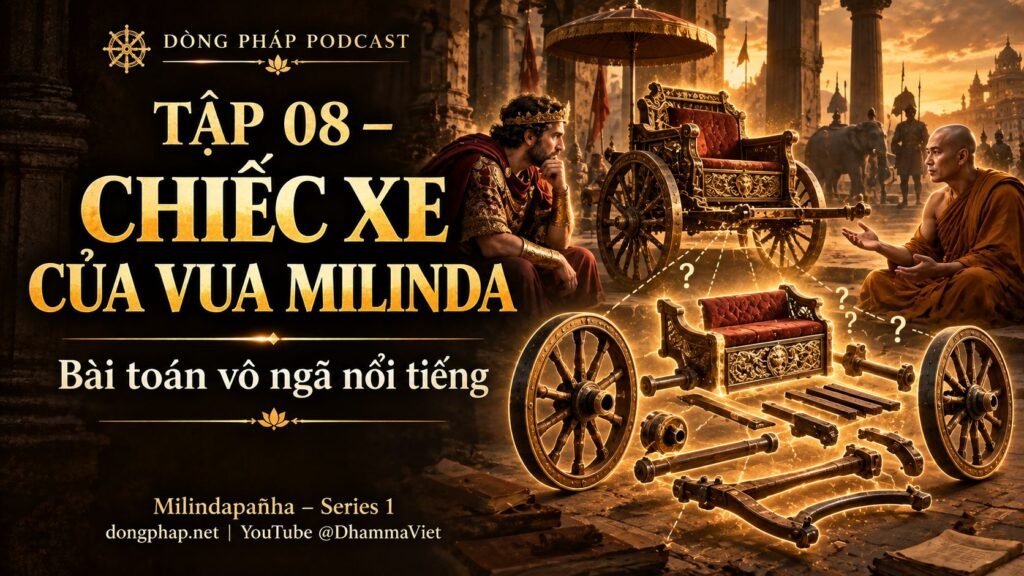
King Milinda’s chariot and the puzzle of non-self
The king has just accused Nāgasena of lying. The monk doesn’t argue; he simply asks a very ordinary question: “How did Your Majesty come here?” And the most famous simile of the Milindapañha begins.
Welcome to everyone listening to Dòng Pháp Podcast. The previous episode stopped at its tensest moment: King Milinda declared that “Nāgasena” was only an empty sound and that the monk had lied before a large assembly. An ordinary person cornered like that would rush to defend himself. Not Nāgasena. He smiled and asked about something that seemed to have nothing to do with it.
īsā, akkha, cakka — pole, axle, wheel.
aṅgasambhāra — the assembling of parts.
sammuti — convention, common designation.
satta — a being, a “person” in ordinary usage.
PART 1 On foot or by chariot?
Nāgasena asked: “Your Majesty, you were raised in luxury. At midday, under the blazing sun, with the sand scorching hot, did you come here on foot or by chariot?” “I came by chariot.”
“If Your Majesty came by chariot, please show me: what is the chariot? Is the pole the chariot?” “No.” “Is the axle the chariot?” “No.” “The wheels? The body? The flagstaff? The yoke? The reins? The goad?” “No, no.” “Then are all these parts put together the chariot?” “No.” “Then is there something apart from these parts that is the chariot?” “No, not that either.”
And Nāgasena handed back the accusation word for word: “I ask and ask, and I find no chariot. ‘Chariot’ is only an empty sound. Your Majesty, foremost ruler of Jambudīpa, why do you lie in saying you came by chariot?”
The five hundred Yonakas applauded. Perhaps for the first time in their lives, they watched their king walk into exactly the trap he had just set.
PART 2 The king answers himself
Milinda was intelligent, and he understood at once: “Venerable sir, I am not lying. It is because there is a pole, an axle, wheels, a body, a flagstaff, that there is the name, the ordinary expression, ‘chariot’.”
Nāgasena nodded: “Excellent, Your Majesty understands what a chariot is. In the same way, because there are hair of the head, hair of the body… because there are form, feeling, perception, formations and consciousness, there is the ordinary name ‘Nāgasena’. But in the ultimate sense, no person is to be found here.”
It is not that there is no chariot. It is only that “chariot” is not an object sitting somewhere apart from its parts.
PART 3 The verse of a bhikkhunī
Nāgasena did not invent this simile. He quotes the bhikkhunī Vajirā in the Connected Discourses, when Māra came and asked her who created a being and where it came from:
evaṃ khandhesu santesu, hoti sattoti sammuti.
“Just as with an assemblage of parts the word ‘chariot’ is used, so when the aggregates exist there is the convention ‘a being’.”
This detail is precious: the chariot simile is rooted in the suttas themselves, and the first person to say it was a nun. Nāgasena simply carried it from the hermitage into the royal court.
PART 4 The chariot in everyday life today
Few people ride horse-drawn chariots nowadays, but the simile is easy to update. A motorbike: take it apart and there are wheels, an engine, a seat, nuts and bolts; none of them is “the motorbike”, yet no one walks to work because of that. A football team: the players change, the coach changes, the shirt changes colour, and the fans still cheer the same name. No one says the team is “fake”; but no one dissects the stadium looking for the corner where “the soul of the team” lies, either.
The self works in exactly the same way. There is a body, there are feelings, perceptions, intentions and awareness. From these there are the names “I”, “you”, “he”, “she”. Those names are usable, necessary, and we must take responsibility for them. But look for a fixed “owner” inside, and none will be found. That is the “puzzle of non-self”: not a subtraction that makes the person disappear, but a calculation showing that the person was never a single solid lump.
In practice, the chariot simile becomes a concrete way of seeing. When anger flares up, instead of thinking “I am angry”, try taking the “chariot” apart: there is heat in the chest, a quickened heartbeat, thoughts repeating over and over, the urge to retort. When each part is seen clearly, the anger is no longer a dense, heavy mass. It becomes lighter, easier to let go.
But if “Nāgasena” is only a name, how does a name, a number of years, relate to the real person? Next episode: is a designation the person?
Thank you for listening. If you found this helpful, please leave a comment, subscribe to the channel, like and share it with those who may benefit. Namo Sakyamuni Buddha.
• No part is the chariot; nor is there a chariot apart from the parts. “Chariot” is a name dependent on the parts.
• Likewise, “Nāgasena” is a convention dependent on the five aggregates; no fixed entity is found.
• The simile is rooted in the verse of the bhikkhunī Vajirā (SN 5.10).
• In practice, “taking apart the chariot” of an emotion helps us see it as components arising and passing away.
Text: Milindapañhapāḷi, Mahāvagga — the chariot simile (ratha).
Compare: SN 5.10 Vajirā Sutta; Visuddhimagga XVIII reuses the chariot simile.
Previous episode: Episode 07: Who is Nāgasena if there is no fixed Nāgasena? (in Vietnamese) · Next episode: Episode 09: Is a designation the person? (in Vietnamese)
The series Milindapañha – Milinda’s Questions — 72 episodes following the table of contents of the Milindapañhapāḷi. More English translations:
- What Are the Four Immeasurables? Loving-Kindness, Compassion, Joy, Equanimity
- Milinda’s Questions – Episode 57: Do Arahants Still Feel Fear?
- Milinda’s Questions – Episode 10: Nāma-rūpa – How Do Mind and Matter Live?
- Greed, Hatred and Delusion: The Three Poisons and the Three Unwholesome Roots
- Is Kamma Fate? What Karma Really Means in Buddhism
Listen to and read all 72 episodes in order (Vietnamese original)
🎧 Listen to Episode 08 on YouTube – DhammaViet channel (in Vietnamese)
👉 Watch the video podcast: Milinda’s Questions Episode 08 on YouTube · Full 72-episode playlist
If you find it helpful, please Like, Subscribe to the DhammaViet channel and leave a comment under the video to discuss the Dhamma together. Sādhu! 🙏


