
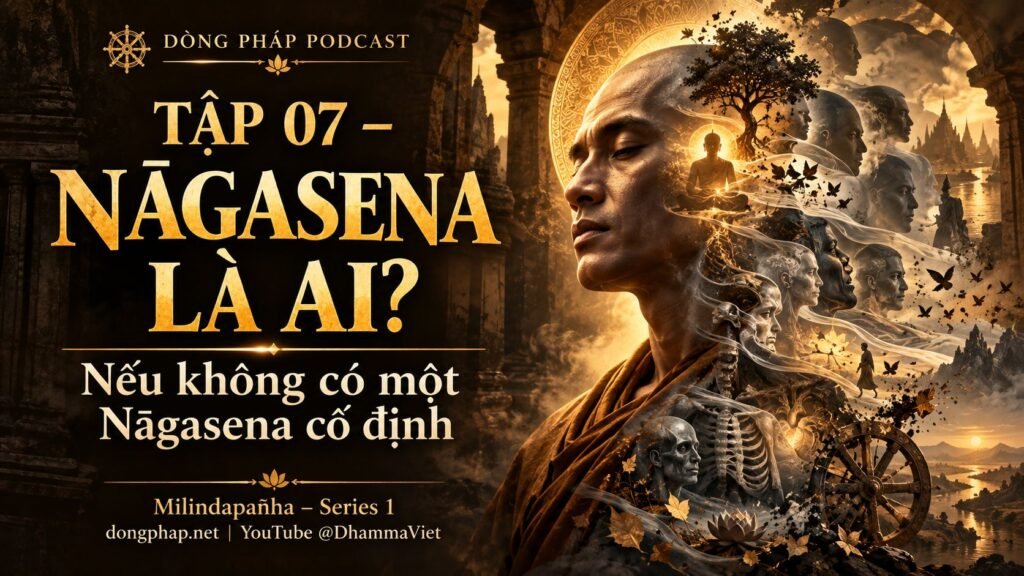
Who Is Nāgasena If There Is No Fixed Nāgasena?
The first question seems the easiest in the world: “What is your name?” But the reply shakes the whole concept of a “person”. The king strikes back at once: then who wears the robe, who keeps the precepts, who practises?
Welcome, dear listeners of the Dòng Pháp Podcast. Part II begins today. It is called the Mahāvagga, the “great chapter”, and it opens with the most familiar question of any meeting: “May I ask your name?” At a party, that question merely opens the small talk. In Sāgala, it opened one of the most famous philosophical dialogues in Asia.
saṅkhā, samaññā, vohāra — reckoning, common appellation, ordinary usage.
puggala — person, individual.
upalabbhati — is found, is apprehended.
anattā — non-self, the absence of a permanent, controlling self.
PART 1 A strange answer
The king asked: “How are you known, venerable sir? What is your name?” Nāgasena replied:
“Great king, I am known as Nāgasena… But ‘Nāgasena’ is only a reckoning, an appellation, a designation, a term in common use, a mere name; no person is found here.”
Picture the scene. Five hundred Yonakas and a great assembly of monks are listening. And the monk who has just been asked his name says: yes, there is a name, but behind the name there is no “one”. The king must have smiled the smile of someone who has just caught a slip.
PART 2 The king strikes back
Milinda turned to the assembly: “Listen, all of you! Nāgasena says there is no person. Can that be accepted?” Then he fired off questions: if there is no person, then who offers robes and alms bowls? Who uses them? Who keeps the precepts? Who practises? Who realises the paths and fruits? Who kills, who steals? If there is no one, then there is no good, no evil, no result of kamma. If someone killed you, they would not be guilty of murder. You would have no teacher and no ordination!
This argument is as sharp as a knife. It touches exactly the worry so many people have when they first hear about non-self: if there is no self, what does ethics stand on? Why practise, and who is practising?
PART 3 Searching for Nāgasena from head to toe
Not stopping there, the king launched a “search”. Is the head hair Nāgasena? No. Body hair, nails, teeth, skin? Flesh, sinews, bones, marrow? No. Is bodily form Nāgasena? Feeling? Perception? Volitional formations? Consciousness? No, no, no. All five aggregates put together? Also no. Is there something outside the five aggregates that is Nāgasena? Also no.
Milinda concluded triumphantly: “I ask and ask, yet find no Nāgasena anywhere. ‘Nāgasena’ is just an empty sound! You have told a lie!”
What is interesting is this: the king thought he was refuting Nāgasena, but in fact he was doing exactly the work of an insight meditator — analysing the person into parts and discovering that no part is the “owner”. He searched correctly; he simply did not yet understand what he had just found.
The “person” cannot be found however long one searches — not because one is searching wrongly, but because there has never been a separate “person” there to be seen.
PART 4 Two levels of truth
To understand Nāgasena, we need the key that the commentarial tradition calls the two levels of truth. The conventional level (sammuti): there is Mr A and Ms B, there is a monk named Nāgasena, there is a giver and a receiver. The ultimate level (paramattha): there are only phenomena, mind and matter, arising and passing away according to conditions.
These two levels do not clash. They are like two ways of looking at a photo on your phone. Viewed normally: the face of a loved one. Zoomed in all the way: just tiny dots of colour. No one says that face is “fake” and then stops loving that person. But no one goes looking for the “loved one” inside a single dot of colour either.
Nāgasena does not deny that someone wears the robe or keeps the precepts. He only says that “Nāgasena” is a paññatti, a name based on the coming together of many factors. That name is usable, necessary and true at the conventional level. But if you look for a fixed entity standing behind the name, you will not find it — na upalabbhati.
In the Discourse on the Characteristic of Non-Self (SN 22.59), the Buddha teaches that the five aggregates are not “mine”, not “I am this”, not “my self”, because they are impermanent, suffering, and not subject to one’s will. Nāgasena’s words are that very sutta brought out for cross-examination in the royal court.
For the practitioner, the lesson is very close at hand: when sitting in meditation, try to “find” the one who is sitting. There is a sensation in the legs, there is breathing, there is a thought, there is a sound. Where is the sitter? No need to rush to a conclusion. Just look closely, and the big everyday “I” will thin out by itself.
The king has accused Nāgasena of lying. How will he respond? The answer lies in a chariot.
Thank you for listening. If you found this helpful, please leave a comment, subscribe, like and share it with those who may benefit. Namo Tassa Bhagavato Arahato Sammāsambuddhassa.
• “Nāgasena” is a conventional designation (paññatti); no substantial person is found in it (na hettha puggalo upalabbhati).
• Milinda strikes back: if there is no person, who keeps the precepts, who practises, who receives the results?
• Analysing from head hair to the five aggregates, no part is Nāgasena — the king unwittingly does exactly the work of insight meditation.
• The key: two levels of truth, conventional (sammuti) and ultimate (paramattha).
Text: Milindapañhapāḷi, Mahāvagga — Paññattipañha (the question on names).
Comparison: SN 22.59 Anattalakkhaṇa Sutta; the two levels of truth according to the Abhidhamma and commentarial tradition.
Series Milindapañha – The Questions of King Milinda — 72 episodes following the table of contents of the Milindapañhapāḷi. More translated articles:
- What Is Theravāda Buddhism? A Complete Guide
- Namo Tassa Bhagavato Arahato Sammāsambuddhassa: Discovering Its Sacred Meaning
- Episode 1: What Is the Sūtra of Immeasurable Life? Why Read It in the Light of the Pāli Canon?
- What Is the Pāli Canon (Tipiṭaka)? A Complete Guide
- Where Does Language Reach Its Limit?
Listen to and read all 72 episodes in order (Vietnamese original)
🎧 Listen to Episode 07 on YouTube – DhammaViet channel (in Vietnamese)
👉 Watch the podcast video: The Questions of King Milinda, Episode 07 on YouTube (in Vietnamese) · Full 72-episode playlist (in Vietnamese)
If you found it helpful, please Like, subscribe to the DhammaViet channel and leave a comment under the video to share in the Dhamma. Sādhu! 🙏
Translated from the Vietnamese original: Milinda Vấn Đạo – Tập 07: Nāgasena là ai nếu không có một Nāgasena cố định?


