
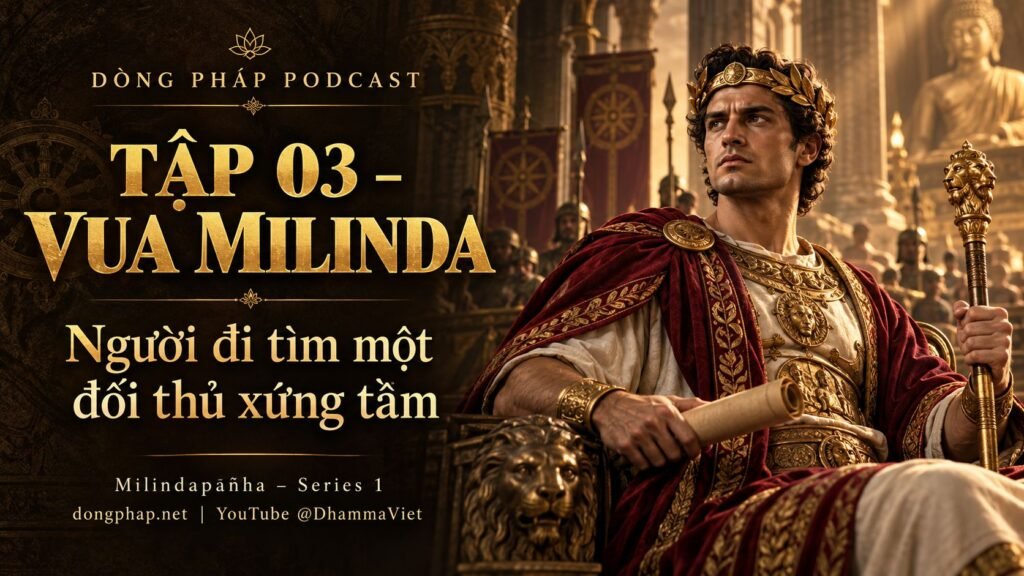
Milinda – the king who searched for someone to answer him
Learned, skilled in debate, “hard to approach, hard to defeat” — King Milinda questioned every famous teacher, then asked a monk why one should go forth. No one could answer. And the king sighed.
Greetings to everyone listening to Dòng Pháp Podcast. In the last episode we strolled around the city of Sāgalā, a wealthy metropolis buzzing with debate. Today we meet the man at the head of that city: a king who had everything except one thing — someone capable of answering his questions.
pabbajjā — going forth into homelessness.
dhammacariyā, samacariyā — living by the Dhamma, living an upright and pure life.
Jambudīpa — the Rose-Apple Land, the land of human beings.
vicikicchā — doubt that makes the mind waver; one of the five hindrances.
PART 1 Portrait of a “demanding customer”
The text describes King Milinda with a string of praise: paṇḍito byatto medhāvī paṭibalo — learned, accomplished, intelligent and capable. He had mastered every branch of learning of his age: orally transmitted scriptures, law, arithmetic, music, medicine, the art of war, astronomy. Most importantly, he was a debater who was durāsado duppasaho, “hard to approach, hard to defeat”, regarded as the foremost among the doctrinal teachers of his day.
Anyone who has been in business knows this kind of customer: he asks in great detail, asks about things the seller hasn’t even thought of, and the moment an answer gets a little vague he keeps probing until the gap… in the seller’s knowledge shows. Many people dread customers like that. But good professionals value them, because they force us to understand our product right down to its roots. Milinda is the “demanding customer” of the Buddha-Dhamma.
PART 2 A free afternoon
The text relates that one day, after reviewing his troops, the king saw that it was still early and said to his ministers: “The day is still long. What shall we do if we go back into the city now? Is there some ascetic or brahmin who could converse with me and dispel the doubt in my heart?”
It sounds like a question about afternoon entertainment, but the word “doubt” reveals something else. The king was not merely looking for an opponent to beat. He had real questions lying quietly in his heart that nobody had yet resolved.
He was taken to meet famous teachers, names that also appear in the Sāmaññaphala Sutta: Pūraṇa Kassapa, Makkhali Gosāla, Ajita Kesakambalī and others. He asked. They answered. He asked again. They floundered. He asked one more question. They fell silent. It was like a job interview in which every candidate fails at the second question: the interviewer isn’t pleased to have won, but sad that the position is still vacant.
PART 3 “Why go forth?”
Then the king went to see the Elder Āyupāla at the Saṅkheyya monastery. His question was very direct: “Venerable sir, why do you go forth? What is your supreme goal?” The elder replied: we go forth in order to live by the Dhamma and to live an upright and pure life.
Milinda immediately retorted: “Are there any householders who live by the Dhamma?” Āyupāla admitted that there were. The king pressed on: “Then going forth is pointless. You must have gone forth because of bad kamma from past lives, so that now you have to eat only one meal a day and sleep in the open!” The Elder Āyupāla fell silent.
The king’s Yonaka courtiers whispered to him: “This elder is learned, but he is flustered and cannot reply.” The king looked around, saw that everyone remained calm yet nobody spoke, and exclaimed:
“Alas, empty indeed is this Jambudīpa, nothing but chaff! There is no ascetic or brahmin who dares to converse with me and dispel my doubt.”
The word palāpa originally refers to husks and empty grain. To the king at that moment, a whole vast land seemed like a granary full of empty husks. His words sound arrogant, but read them slowly and you will sense the loneliness: a person full of questions who cannot find anyone deep enough to talk to.
An answer that is correct but not deep enough can still fall into silence when it meets a questioner who is skilled enough.
PART 4 The lesson of a silence
Āyupāla’s answer was not wrong; it simply stopped at the level of a slogan. The Sāmaññaphala Sutta (DN 2) explains more deeply: household life is cramped and dusty; the life of one gone forth is wide open like the sky, and it is easier there to live the holy life in its fullness and purity, like a polished conch shell. It is not that a householder cannot practise, but that going forth provides a more favourable environment for the ultimate goal. Later, in Part IX, this very question of “householder or renunciant” will return and be answered fully by Nāgasena.
As for the king, we need to distinguish two kinds of doubt. Doubt that seeks to understand is a healthy motivation; the Kālāma Sutta (AN 3.65) encourages us to see and know for ourselves rather than believe blindly. But doubt as a habit that makes the mind waver and unable to decide is what the Abhidhamma calls vicikicchā, a hindrance that covers the mind. Milinda’s journey is a movement from the second kind of doubt to the first, and then beyond both.
When we sit in meditation, each of us also has a little “King Milinda” inside, whispering: “Am I sitting the right way?”, “Why haven’t I experienced anything yet?” Don’t chase it away, but don’t let it take the wheel either. Just recognise: “doubting, doubting”. When doubt is seen as a phenomenon that arises and passes away, it no longer sits on the throne; it is just a guest passing through.
The text tells us that after this lament, for twelve years no learned bhikkhu remained in Sāgalā. Was this land really empty? In the next episode we will meet the person who had been prepared specifically for this encounter: the one who carries the torch that dispels the darkness.
Thank you for listening. If you found this helpful, please leave a comment, subscribe to the channel, like and share it with those who may benefit. Namo Sakyamuni Buddha.
• Milinda was learned, skilled in debate, “hard to approach, hard to defeat”, yet he carried real doubts that no one had resolved.
• The teachers of his day and the Elder Āyupāla all failed to stand firm before his questions.
• The lament “Tuccho vata bho jambudīpo” is at once proud and lonely.
• Doubt that seeks understanding is useful; doubt that makes the mind waver (vicikicchā) is a hindrance to be recognised.
Text: Milindapañhapāḷi, Bāhirakathā — the portrait of King Milinda, his meetings with the teachers and with the Elder Āyupāla.
Cross-references: DN 2 Sāmaññaphala Sutta; AN 3.65 Kālāma Sutta; the five hindrances in MN 10.
Translated from the Vietnamese original: Milinda Vấn Đạo – Tập 03: Milinda – vị vua đi tìm người có thể trả lời mình
The series Milindapañha – The Questions of King Milinda — 72 episodes following the table of contents of the Milindapañhapāḷi. More English translations from Dòng Pháp:
- What Is Theravāda Buddhism? A Complete Guide
- Namo Tassa Bhagavato Arahato Sammāsambuddhassa: Discovering Its Sacred Meaning
- Episode 1: What Is the Sūtra of Immeasurable Life? Why Read It in the Light of the Pāli Canon?
- What Is the Pāli Canon (Tipiṭaka)? A Complete Guide
- Where Does Language Reach Its Limit?
Listen to and read all 72 episodes in order (Vietnamese original)
🎧 Listen to Episode 03 on YouTube – DhammaViet channel (in Vietnamese)
👉 Watch the video podcast: The Questions of King Milinda, Episode 03 on YouTube (in Vietnamese) · Playlist of all 72 episodes
If you found this helpful, please Like, subscribe to the DhammaViet channel and leave a comment under the video so we can share the Dhamma together. Sādhu! 🙏


