
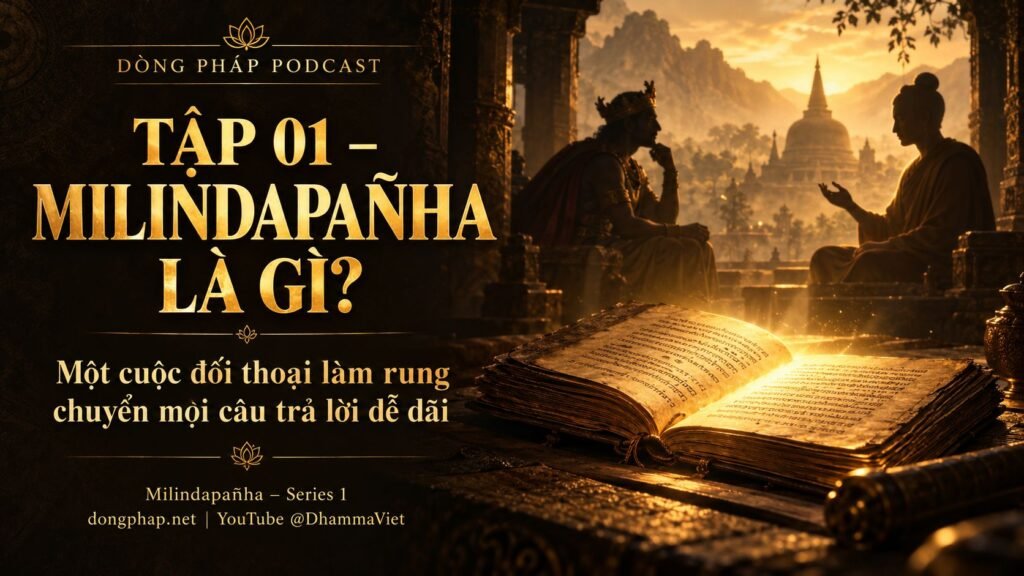
What Is the Milindapañha?
A king of Greek descent, a Buddhist monk, and a dialogue not meant for those who like easy answers.
Welcome, dear listeners of the Dòng Pháp Podcast. Today we open a long journey of seventy-two episodes, walking with two very special figures: a king who likes to ask questions all the way to the bottom, and a monk with a rare gift for untangling knots through surprisingly simple examples.
Most books of philosophy begin with definitions. The Milindapañha does not. It opens with an image of rivers and water:
upagañchi nāgasenaṃ, gaṅgā ca yathā sāgaraṃ.
“There was a king named Milinda, in Sāgala, foremost of cities, who went to Nāgasena as the Ganges goes to the ocean.”
Notice the word sāgara, meaning ocean. The Ganges does not flow into the sea to quarrel with the sea. The river carries its silt, dry branches and floating weeds and pours everything into a place wide enough to hold it. In its very first verse, the text reveals the spirit of the whole book: this is not a story of winners and losers, but of doubts finding a place to settle.
opamā — an example, a simile.
Yonaka — a Greek (Ionian) in Pāli texts.
mātikā — outline, table of contents.
paññā — wisdom.
PART 1 A Greek king in the land of India
Milindapañha literally means “the questions of Milinda”. Vietnamese readers know it as Mi Tiên Vấn Đáp; this series has chosen the title Milinda Vấn Đạo — “Milinda asks about the Way” — because what the king was really asking about was not knowledge, but the path.
Many scholars identify Milinda with King Menandros (Menander), a king of Greek descent who ruled north-western India around the second century BCE. Coins bearing his name — Greek script on one side, Indian script on the other — are still being dug up today. Imagine it: a descendant of the armies that followed Alexander the Great, raised on Greek philosophy, now sitting face to face with an Indian monk to ask about the self, about kamma, about Nibbāna. An encounter of East and West more than two thousand years ago.
His interlocutor is the Elder Nāgasena, an arahant thoroughly versed in the Three Baskets. As for the work’s status, each tradition places it differently: Myanmar includes the Milindapañha in the Khuddaka Nikāya, that is, fully within the Tipiṭaka; Sri Lanka and Thailand regard it as a non-canonical but highly authoritative book. The great commentator Buddhaghosa cites the Milindapañha many times as a reliable source.
We also need to separate two layers. The first is what the text tells: a dialogue at Sāgala. The second is what scholars have noticed: the text was very likely expanded over several generations. This series reads the Milindapañha first of all as a Pāli text for learning the Dhamma, without rushing to turn it into a historical transcript.
PART 2 The map the book draws of itself
The Milindapañha presents its own outline from the start, like a guide handing you a map before entering the forest:
That is: the background story of former deeds; the questions of Milinda; questions on the characteristics of phenomena; the “two-horned” dilemma questions, where two teachings seem to clash; questions on inference; and questions by way of similes.
The seventy-two episodes of the series follow exactly that order: from the city of Sāgala and the two main figures, to questions about the person and non-self, through mental phenomena, time and Nibbāna, then into the “thorniest” territory of the dilemmas, and finally the section on inference, the story of Vessantara, dreams, death and Nibbāna.
A good question is not a wall blocking the road. A good question is a door.
PART 3 Not for those who like easy answers
Think back to buying a new washing machine. The manual is sixty pages thick and almost nobody reads it. But the day the machine flashes “E3”, someone immediately turns to the E3 page and reads every line, even the small-print footnotes. Many people come to the Buddha’s teaching in just the same way: skimming when life is smooth, really reading only when life throws an error.
Milinda was not an easy man. He was widely learned, a skilled debater, and had embarrassed many teachers. Meet a parent like that at a school meeting and the homeroom teacher would probably need a few days off. That is exactly why the answers in the book are trustworthy: they had to pass through a very fine filter.
Nāgasena, for his part, almost never answers with a dry definition. He answers with opamā: the chariot, the lamp, the mango, the elephant’s footprint, the gatekeeper. The text’s introduction says these answers are grounded in the Suttas, the Vinaya and the Abhidhamma, and illuminated by reasoning and examples. Studying the Milindapañha, then, means learning two things at once: the content of the Dhamma, and the art of presenting the Dhamma.
PART 4 Today’s questions
What keeps the Milindapañha alive is that King Milinda’s questions are exactly the questions of people today. If there is no permanent self, who is hearing these words? If there is no soul, what is reborn? If the Buddha knew everything, why do some suttas seem to contradict each other? Why do good people still meet with misfortune? Where is Nibbāna?
In the Aṅguttara Nikāya, the discourse on answering questions (AN 4.42) lists four ways of answering: answering directly in one word, answering by analysis, answering with a counter-question, and setting the question aside. The Milindapañha is like a huge practical workshop in those four ways. As you listen to later episodes, try to notice: which way is Nāgasena using now, and why did he choose it?
For a practitioner of insight meditation, questions are not for collecting more answers. A question at the right moment can turn the mind back toward what is actually happening. From pañha, question, to paññā, wisdom: that is the red thread running through the whole series.
The next episode takes a stroll around the city of Sāgala, where it all began. Why would a book about the Dhamma open with streets, markets and shops?
Thank you for listening. If you found this helpful, please leave a comment, subscribe, like and share it with those who may benefit. Namo Sakyamuni Buddha.
• The Milindapañha is “the questions of King Milinda”, a dialogue between a king of Greek descent and the Elder Nāgasena.
• The Pāli text states its own outline: Pubbayoga, Milindapañha, Lakkhaṇapañha, Meṇḍakapañha, Anumānapañha, Opammakathāpañha.
• Its hallmark is teaching through similes (opamā), grounded in the Suttas, Vinaya and Abhidhamma.
• The 72-episode series moves from pañha, question, to paññā, wisdom.
Text: Milindapañhapāḷi, the opening verse “Milindo nāma so rājā…” and the six-part outline (mātikā).
Comparison: AN 4.42 Pañhabyākaraṇa Sutta — four ways of answering questions.
Note: The status of the Milindapañha within the Tipiṭaka differs among Theravāda traditions. The identification of Milinda with Menander rests on modern scholarship and ancient coins.
Series Milindapañha – The Questions of King Milinda — 72 episodes following the outline of the Milindapañhapāḷi. More translated articles:
- What Is the Noble Eightfold Path? The Way to End Suffering
- The Questions of King Milinda – Episode 49: Do Trees Have a Mind?
- Episode 21: A Dried Dung Stick – Asked “What Is Buddha?”, Why Such a Shocking Answer?
- What Are the Five Aggregates? The Five Parts of a “Person”
- The Three Marks of Existence: Impermanence, Dukkha, Non-Self
Read and listen to all 72 episodes in order (Vietnamese original)
🎧 Listen to Episode 01 on YouTube – DhammaViet channel (in Vietnamese)
👉 Watch the video podcast: Episode 01 on YouTube · Full 72-episode playlist
If you found it helpful, please like, subscribe to DhammaViet and leave a comment under the video to share in the Dhamma. Sādhu! 🙏


