
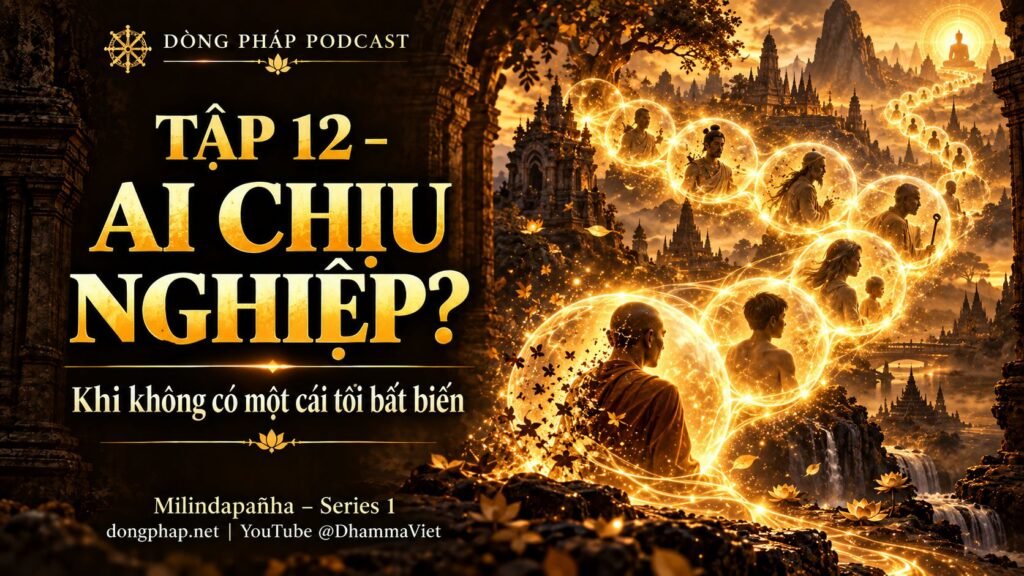
Without an unchanging self, who bears the karma?
The mango thief argues: “The mangoes I picked from the tree are not the mangoes he planted!” The man who lit a fire argues: “The fire burning the field is not the little fire I warmed myself by last night!” Two imaginary trials help Nāgasena untangle the thorniest question about non-self.
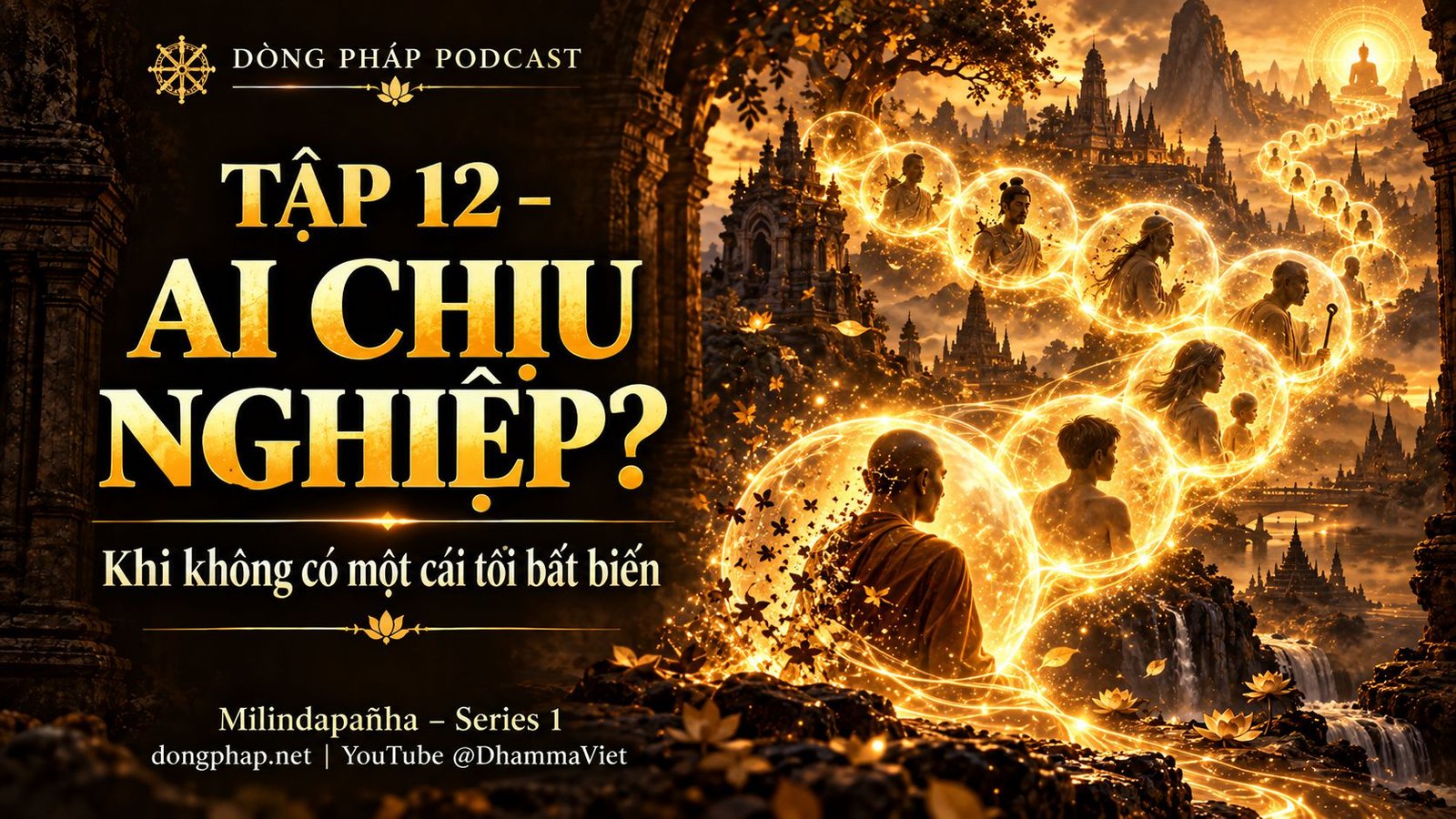
Welcome to everyone listening to Dòng Pháp Podcast. There is a question that almost everyone who studies non-self stumbles over: if there is no permanent self, does the person who does evil today have anything to do with the one who meets the result later? If they are not the same person, won’t the wrongdoer get away with it? King Milinda asks exactly that.
vipāka — result, the ripened fruit of karma.
paṭisandhi — rebirth-linking, the connection to a new life.
santati — continuity, an unbroken succession.
nāmarūpa — mind-and-body (name-and-form).
PART 1 A tricky question
Nāgasena has just said: this mind-and-body does wholesome or unwholesome karma, and because of that karma another mind-and-body is reborn. The king seizes at once on the word “another”:
“Venerable sir, if it is not that very mind-and-body that is reborn, wouldn’t that person be freed from his evil deeds?”
Nāgasena answers: if there were no rebirth, then yes, he would be freed. But because there is rebirth, he is not freed from his evil deeds. A short answer, but the king asks for an example. And Nāgasena offers two “trials”.
PART 2 The first trial: the mango thief
A man steals another man’s mangoes. Caught and brought before the king, he argues that the mangoes he picked are not the mangoes the other man planted. The owner planted a mango seed, while he picked fruit from a tree; so he does not deserve punishment.
Nāgasena asks: does that man deserve punishment? The king answers immediately: of course he does. Why? Because whatever he says, the later mangoes grew from the earlier mango; without the earlier seed there would be no later fruit.
Nāgasena concludes: in the same way, this mind-and-body does karma, and because of that karma another mind-and-body is reborn. Because the later mind-and-body continues from the earlier one, it is not freed from evil deeds.
Imagine a modern lawyer defending a client along these lines: “Your Honour, according to science, almost all of my client’s cells have been replaced since the day of the crime; the person standing here is no longer the person of back then.” The whole courtroom would probably burst out laughing. Nobody accepts that argument, because everyone intuitively understands that continuity is enough to carry responsibility, even though nothing stands still and unchanging.
You don’t need an unchanging self to be responsible. You only need an unbroken continuity.
PART 3 The second trial: the field fire
In the cold season a man lights a fire to warm himself, and when he is done he walks away without putting it out. The fire spreads to another man’s field and burns the whole crop. Caught, he argues that the fire he lit was one fire, and the fire that burned the field was another, so he is not guilty.
Again the king rules: guilty. Because the later fire was born from the earlier fire. Without the first spark, there would be no later blaze.
Both examples teach one thing: santati, continuity. The mango does not stand still, the fire does not stand still, yet they follow one another according to causes and conditions. That very continuity is the “thread” of karma; no soul standing in the middle is needed to be the one who receives the result.
PART 4 Non-self is not a licence to escape responsibility
This is the point most often misunderstood. Some people hear “non-self” and conclude: then nobody has to bear anything, so do whatever you like. The Milindapañha shuts that line of reasoning firmly. The Buddha teaches in the Aṅguttara Nikāya (AN 5.57) that each person should often reflect: I am the owner of my karma, the heir of my karma; karma is my origin, my relative, my refuge. The word “owner” here does not contradict non-self; it is conventional language to stress that this stream of mind will reap what it sows.
On the contrary, non-self makes responsibility even more serious. If there were an unchanging soul, one might think, “Whatever happens, I’m still me.” But when you see that each action is shaping the person to come, then every word and every thought carries weight. The person of the future is not some stranger; that person is being moulded right now.
For the practitioner, the lesson is very practical. When you are about to say something in anger, remember the warming fire: a small forgotten spark can become a blaze across a whole field. When you do a small good deed, remember the mango seed too: today it is only a seed, but continuity will carry it into a tree and into fruit.
But if there is only continuity, are the child of long ago and the adult of today one person or two? Next episode: yesterday’s person and today’s person.
Thank you for listening. If you found this helpful, please leave a comment, subscribe to the channel, like and share it with those who may benefit. Namo Sakyamuni Buddha.
• Milinda asks: if the reborn mind-and-body is “another”, isn’t that person freed from evil deeds?
• Nāgasena: without rebirth he would be freed; because there is rebirth, he is not.
• The mango thief and the field fire: the later arises from the earlier, so responsibility remains.
• Non-self is not a licence to escape responsibility; continuity (santati) carries karma onward (AN 5.57).
Text: Milindapañhapāḷi, Mahāvagga — the question of rebirth of mind-and-body and evil deeds (the mango-thief and field-fire similes).
Compare: AN 5.57 Abhiṇhapaccavekkhitabbaṭhāna Sutta; MN 135 Cūḷakammavibhaṅga Sutta.
Previous episode: Episode 11: Without a self, who is living? (in Vietnamese) · Next episode: Episode 13: Yesterday’s person and today’s person – the same or different? (in Vietnamese)
The series Milindapañha – Milinda’s Questions — 72 episodes following the table of contents of the Milindapañhapāḷi. More English translations:
- What Is Theravāda Buddhism? A Complete Guide
- Namo Tassa Bhagavato Arahato Sammāsambuddhassa: Discovering Its Sacred Meaning
- Episode 1: What Is the Sūtra of Immeasurable Life? Why Read It in the Light of the Pāli Canon?
- What Is the Pāli Canon (Tipiṭaka)? A Complete Guide
- Where Does Language Reach Its Limit?
Listen to and read all 72 episodes in order (Vietnamese original)
View the whole series →🎧 Listen to Episode 12 on YouTube – DhammaViet channel (in Vietnamese)
👉 Watch the video podcast: Milinda’s Questions Episode 12 on YouTube · Full 72-episode playlist
If you find it helpful, please Like, Subscribe to the DhammaViet channel and leave a comment under the video to discuss the Dhamma together. Sādhu! 🙏


