
Four Bottomless Oceans: How the Ancients Measured the Depth of the Dhamma
Before inviting the learner into the water, the Aṭṭhasālinī does something few books dare to do: it says plainly how deep this sea is — with a scale of four oceans, only one of which has a bottom.
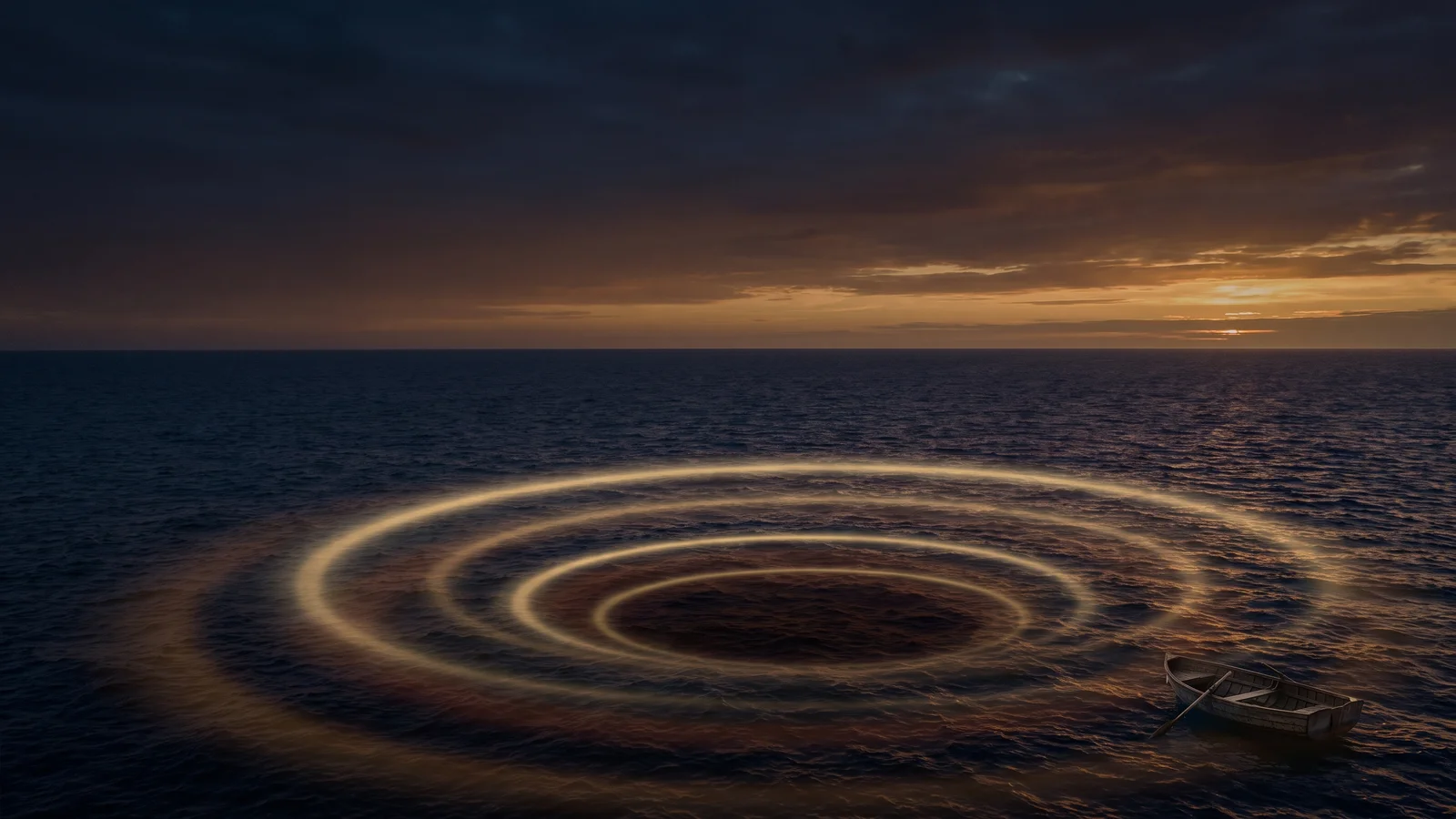
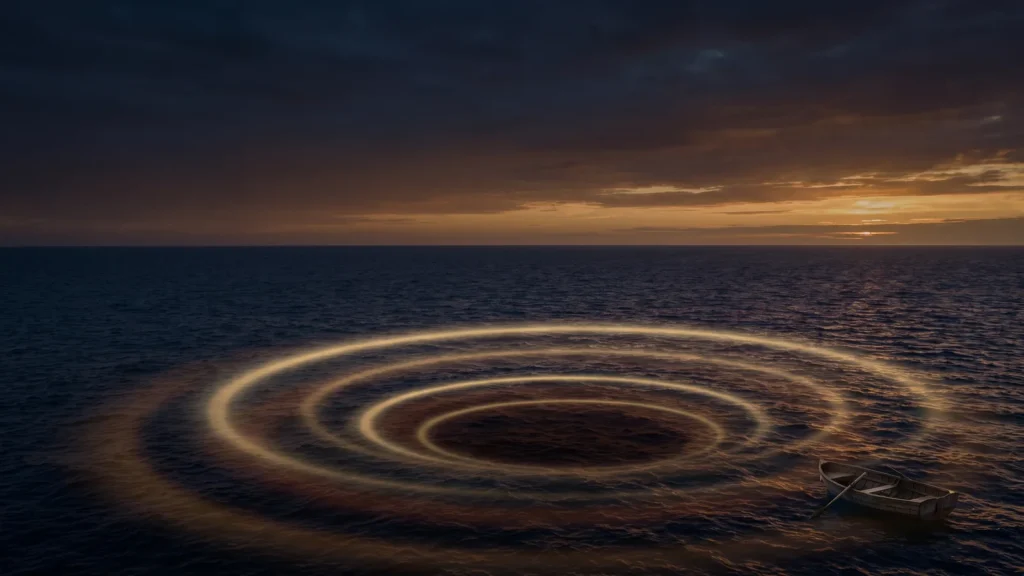
A good salesperson never opens with how difficult the product is. The Aṭṭhasālinī does the opposite. Right in its introductory section, before the learner has even touched the first page of the Dhammasaṅgaṇī, the commentary puts up a signpost: “Idāni imassa abhidhammassa gambhīrabhāvavijānanatthaṃ cattāro sāgarā veditabbā” — “now, in order to understand the profundity of this Abhidhamma, four oceans should be known” (VRI, p.3). Then it lists them: the ocean of saṃsāra, the ocean of water, the ocean of method, the ocean of knowledge. Four oceans set side by side like four levels of a single measurement — and the most astonishing thing is this: on that scale, the real ocean, the sea in which ships still sink, is the shallowest. This episode swims across the commentary’s four oceans — slowly — to understand what attitude the ancients wanted a learner to carry into the Abhidhamma Piṭaka.
PART 1The first ocean: saṃsāra — no beginning edge to be found
The first ocean is defined by a tightly compressed verse:
Abbocchinnaṃ vattamānā, saṃsāroti pavuccatīti.
“The succession of aggregates, of elements and of sense bases, going on without interruption — this is called saṃsāra.”— Aṭṭhasālinī, Nidānakathā (VRI edition, tipitaka.org, p.3) · Reference translation from the Pāḷi original
Notice: the definition has no character in it. Saṃsāra is not “a soul passing through many lives” — it is a chain of aggregates linked without a break, like the lesson on character-free language in part 2. And the commentary adds what makes this ocean “bottomless”: purimā koṭi na paññāyati — no first edge can be discerned. No one can point to the moment that chain began; go back a hundred years, a thousand aeons, a hundred thousand aeons — it is still flowing. A modern reader used to asking “when did the universe begin?” will find this tradition’s answer strange yet consistent: for the stream of experience, the question of a starting edge has no answer — the task is not to find the edge but to find the way out.
PART 2The second ocean: the real ocean — the only one that can be measured
The second ocean is an ocean in the literal sense: jalasāgara, the salt-water ocean, which the commentary describes as eighty-four thousand yojanas deep, impossible to measure out even with a hundred thousand bushel-measures (VRI, p.3). For the ancients it was the most concrete image of vastness. But its place on the scale of four oceans is what is interesting: it stands there as a point of comparison — the most boundless thing the senses can touch, placed beside things more boundless that the senses cannot reach. Like setting the highest mountain next to the distance between the stars: the mountain is still high, but the comparison has changed units. The ocean — the terror of every seafarer — modestly accepts, on this scale, the role of “the shallowest of the four”.
The real ocean is the most boundless thing the senses can touch — and the shallowest one on the commentary’s scale.
PART 3The third ocean: the Three Baskets — a sea you can swim but never empty
The third ocean is the one the student of Abhidhamma faces directly:
“What is the ocean of method? The Word of the Buddha in the Three Baskets. For indeed, in sons of good family who are endowed with faith, abounding in confidence, and excelling in wisdom, as they reflect on the two bodies of text [the Vinaya and the Abhidhamma], boundless joy and gladness arise.”— Aṭṭhasālinī, Nidānakathā (VRI edition, tipitaka.org, p.4) · Reference translation from the Pāḷi original
A detail worth pausing on: this ocean is defined not by saltiness or depth, but by the joy of those who swim in it — “boundless joy and gladness arise”. The ancients did not measure the Three Baskets by page count; they measured them by the experience of the serious learner: the more one reflects, the more joy one finds, and that joy has no bottom. Anyone who has ever been absorbed in a deep enough subject — music, mathematics, a craft — knows this feeling of “the further in, the wider it gets”. What the commentary asserts is that, with the Buddha’s Word, this feeling is not a honeymoon phase that passes; it is a property of the ocean itself. And among the four oceans, the commentary makes clear: here, nayasāgara is the ocean intended — because the Abhidhamma is the deepest part of that ocean.
PART 4The fourth ocean: knowledge — where all measuring stops
“What is the ocean of knowledge? Omniscient knowledge is called the ocean of knowledge. For ‘this is the ocean of saṃsāra, this is the ocean of water, this is the ocean of method’ — this no one else can know [completely]; only omniscient knowledge can know it.”— Aṭṭhasālinī, Nidānakathā (VRI edition, tipitaka.org, p.4) · Reference translation from the Pāḷi original
The fourth ocean has a nature quite unlike the other three: it is the ocean that can measure the other three. Saṃsāra is vast, the ocean is fathomless, the Three Baskets are endless — but all three only show their true shape within a knowing large enough to hold them entirely: the omniscience of the Awakened One. The table of four oceans, it turns out, is not four items of equal rank; it is a ladder of knowing, and its last rung is exactly what part 4 touched upon: a teaching that “a thousand years of study cannot exhaust”, because it flows from this bottomless ocean.
The first three oceans are vast; the fourth is a knowing large enough to measure the other three.
PART 5The attitude of one who carries a small boat
So what attitude is the “four oceans” signpost meant to create in the learner? Not fear — the commentary sets up this scale right before eagerly leading the learner into each page of the treatise, which means it believes this ocean can be swum. Nor the ambition to drain it dry — the figure of “a thousand years without exhausting it” closes the door on that illusion early on. The intended attitude lies between those two extremes, and it has a familiar name: persistent humility. Someone who knows the ocean has no bottom stops asking “when will I finish learning?” — a question that has killed many a course of study — and begins asking a better one: “how much further did I swim today?”. The pleasant paradox is that only the person who drops the first question can swim furthest with the second.
2. Write two questions side by side: “When will I be done?” and “How much further did I get today?”. Notice how your body feels as you read each one — one tightens, one opens.
3. During the week, whenever you feel discouraged because “there is still so much I don’t know”, replace the first question with the second — and write down one small thing you learned that day.
The four oceans close the great metaphors of the introduction. Only one episode remains in the introductory group of this series: the Aṭṭhasālinī’s most controversial statement — “Abhidhamma is not the domain of disciples; it is the domain of the Buddhas” — and the question it poses for every ordinary learner: then what are we doing here?
So as not to miss the 100-episode journey through this entire commentary, follow the Dòng Pháp Podcast on dongphap.net.
Namo Tassa Bhagavato Arahato Sammāsambuddhassa — Homage to the Blessed One, Śākyamuni Buddha.
Cattāro sāgarā — the four oceans in the Nidānakathā measure the profundity of the Abhidhamma: the ocean of saṃsāra, the ocean of water, the ocean of method (the Three Baskets), the ocean of knowledge (omniscience).
• Saṃsāra is defined without a character: a chain of aggregates, elements and sense bases linked without a break, with no beginning edge to be found.
• The real ocean — the most boundless thing the senses can touch — is only the shallowest ocean on the scale; the Three Baskets are measured by the learner’s bottomless joy; the ocean of knowledge is the knowing that can measure the other three.
• The right attitude: persistent humility — stop asking “when will I be done?”, start asking “how much further did I get today?”.
- In your life, which course of learning was killed by the question “when will I be done?”
- Is there an “ocean” you once feared because of its depth — only to realize that very depth is the reason it is worth swimming?
This article is part of the series Aṭṭhasālinī – Commentary on the Dhammasaṅgaṇī. More articles available in English:
- What Is Theravāda Buddhism? A Complete Guide
- Namo Tassa Bhagavato Arahato Sammāsambuddhassa: Discovering Its Sacred Meaning
- Episode 1: What Is the Sūtra of Immeasurable Life? Why Read It in the Light of the Pāli Canon?
- What Is the Pāli Canon (Tipiṭaka)? A Complete Guide
- Where Does Language Reach Its Limit?
Translated from the Vietnamese original: Bốn biển không đáy: cách người xưa đo độ sâu của giáo pháp


