
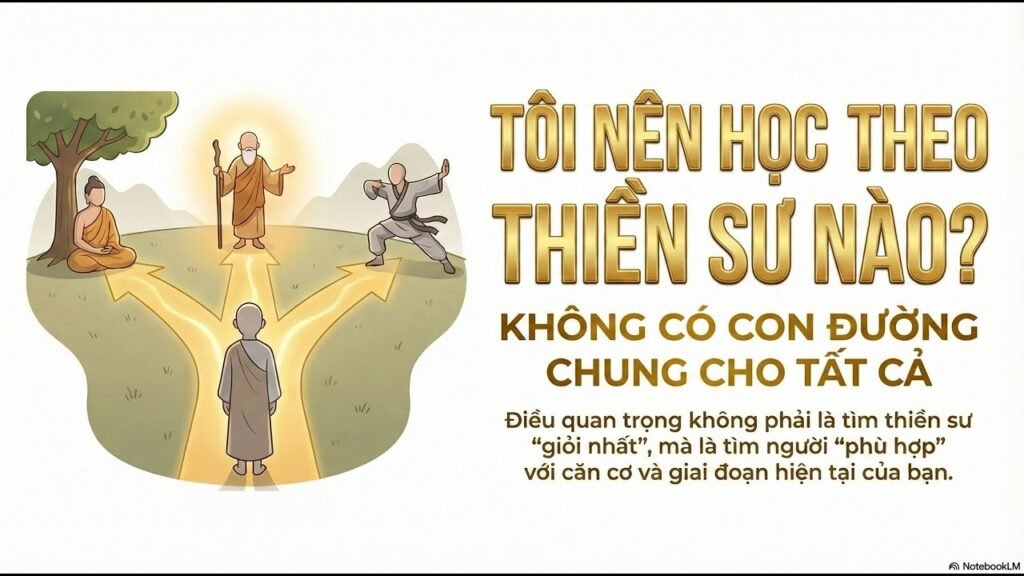
Who should you learn meditation from? The answer few people say
“Which meditation teacher should I follow?” sounds like a perfectly reasonable question. But Vipassanā is a strange path: the more you want a ready-made answer, the easier it is to go astray. This article will not choose a teacher for you; it will help you recognise who is suitable for you at this particular moment.

There is no single best meditation teacher for everyone. The better question is: who helps you suffer less, see your mind more clearly and live more lightly at this stage? The Caṅkī Sutta (MN 95) teaches us to examine a teacher through body and speech, looking for traces of greed, hatred and delusion. The Upaḍḍha Sutta (SN 45.2) says that good friendship, kalyāṇamitta, is the whole of the holy life. The common sign of the right path is less clinging, less tension, less self-torment.
Welcome to everyone listening to Dòng Pháp Podcast. Today’s episode takes up the question we receive more than any other: who should you learn meditation from, and how can you recognise the guide who is right for you?
The question comes in many forms. Should I follow this teacher or that one? Which tradition is the most authentic? Is there a single best teacher?
It sounds a lot like shopping for a phone. You look up reviews online, compare specs, read the five-star and one-star comments. In the end you pick the highest-rated one, take it home and discover it doesn’t fit your hand.
Choosing a guide on the path of meditation is not like choosing a phone. But the mind of the person asking is quite similar: it wants a ready-made, pre-tested answer so it doesn’t have to look for itself.
This article won’t pick a teacher for you. Instead, let’s look together at some questions that can help you recognise one for yourself.
Sakalamevidaṃ, ānanda, brahmacariyaṃ, yadidaṃ kalyāṇamittatā kalyāṇasahāyatā kalyāṇasampavaṅkatā.
Ānanda, this is the entire holy life: good friendship, good companionship, good comradeship. (SN 45.2)
PART 1 Why there is no single best meditation teacher for everyone
In the Discourses, the Buddha did not teach everyone the same meditation subject. Some were taught mindfulness of breathing. Some were taught contemplation of the unattractive. Some were taught loving-kindness. The later commentaries even classify different temperaments — the greed type, the hatred type, the delusion type — each suited to its own subject.
If even the meditation subject depends on the person, the way of guiding depends on the person even more. Some people need a strict teacher; others need a patient one. Some need lots of detailed instruction; others need to be left alone to see for themselves.
In other words, the question “who is the best teacher?” is missing half of itself. The full question must be: best for whom, and at what stage?
PART 2 Three common misunderstandings when choosing a teacher
The first misunderstanding: fame. The more famous the teacher and the more followers they have, the more correct they must be. But fame measures reach, not suitability. A busy restaurant may still not suit one particular person’s taste.
The second misunderstanding: difficulty. The stricter the method and the more hours of sitting, the higher it must be. Some people choose the toughest retreat just to prove something to themselves. The result is double the tension, plus a little pride at having endured so well. The ego gets yet another medal.
The third misunderstanding: you must follow one teacher for life. Some think that once you have chosen a teacher you may never change, and that changing is betrayal. But a first-grader and a university student need different teachers. Being grateful to your former teacher doesn’t mean you must stay in first grade forever.
The path of practice is not about finding the best teacher, but about finding someone who helps you suffer less.
PART 3 The Buddha taught how to examine a teacher
What is interesting is that the Discourses themselves give guidance on this. In the Caṅkī Sutta (MN 95), the Buddha describes how a person examines a bhikkhu before placing faith in him. They observe whether he has qualities rooted in greed, hatred or delusion. Is it because of greed that he says he knows when he does not know, says he sees when he does not see, or urges others to do what leads to their long-term harm?
Only when they see that his bodily and verbal conduct is not governed by greed, hatred or delusion, and that the Dhamma he teaches is profound and peaceful, not mere reasoning, do they place their faith in him.
In the Kālāma Sutta (AN 3.65), the Buddha speaks of a similar measure: when you know for yourself that these things are wholesome, not criticised by the wise, and when practised lead to benefit and happiness, then practise them. The measure lies not in the teacher’s fame, but in the results in the learner’s mind.
PART 4 Four self-assessment questions
In that spirit, here are four very practical questions for assessing yourself after a period of learning with a teacher or a tradition.
First: after hearing the Dhamma, do you feel less tense? Or do you go home more worried that you are practising wrong, more afraid that you are inadequate?
Second: do you see your own mind more clearly? That is, do you notice anger, anxiety and desire earlier than before, even a little?
Third: are you becoming dependent on the teacher? A good guide helps the learner stand more and more on their own. If a week without your teacher leaves your mind in a panic, that is a sign to look at.
Fourth: are you living more lightly in everyday life? Not in the meditation hall, but at home, at work, in traffic jams, when you are criticised.
One misunderstanding needs untangling: less tense does not mean always comfortable. Some stages of practice are very hard and require facing the less beautiful parts of ourselves. The question is not whether it feels pleasant, but whether, in the long run, there is less clinging and less suffering.
PART 5 A different guide for each stage
Beginners usually need clear structure: how long to sit, where to place attention, what to do when the mind wanders. People who have practised for a while usually need someone to point out where they are stuck in ways they cannot see. Those who have gone further sometimes need only a single reminder at the right moment.
Dhammapada verse 76 says: if you find a wise person who points out your faults, like one who reveals hidden treasure, associate with such a person. A good guide sometimes doesn’t make things comfortable, but makes things clear.
If you are undecided, there are a few simple things you can do. Read the suttas to have a common foundation, so you don’t depend entirely on what is said in talks. Try practising seriously, for a long enough period, with one set of instructions, rather than sampling a little everywhere. And observe your own mind with the four questions above.
In Vipassanā practice, even the feeling of indecision is something to be seen. What sensations are in the body when the mind cannot decide? Is there a fear of choosing wrongly behind it? When you see that, the choice often becomes lighter.
2. Identify the misunderstanding. Ask yourself: was my reason for choosing a teacher based on fame, difficulty, or the fear of betrayal?
3. Observe indecision. When the mind is fumbling over a choice, pause for one breath and note the sensations in the body.
• There is no single best meditation teacher for everyone; suitability depends on the person and the stage.
• The Caṅkī Sutta (MN 95) teaches us to examine a teacher for traces of greed, hatred and delusion in body and speech.
• The common sign of the right path: less clinging, less tension, less self-torment, and growing ability to stand on your own.
- Am I looking for a guide, or for someone to make decisions for me?
- After a year of practice, is my everyday life lighter or heavier?
- If I had no one guiding me for a month, what would happen to my practice?
Who is the best person to learn meditation from?
There is no common answer for everyone. The right person is someone who helps you suffer less, see your mind more clearly and live more lightly at your current stage.
How do the scriptures teach us to choose a teacher?
The Caṅkī Sutta (MN 95) teaches us to observe a teacher’s bodily and verbal conduct to see whether it is governed by greed, hatred or delusion, and only then to place our faith in them.
Is changing teachers disrespectful?
Not necessarily. Each stage of practice may need a different guide. You can remain grateful to your former teacher while learning more from someone else.
Upaḍḍha Sutta (SN 45.2) · Caṅkī Sutta (MN 95) · Kālāma Sutta (AN 3.65) · Dhammapada 76 (Dhp 76). Further reading: The Kālāma Sutta: the Buddha taught us not to believe blindly (in Vietnamese).
But if the guide is only one part, where does the rest lie? Perhaps the deeper question is not who to learn from, but what to learn with: with faith, with knowledge, or with your own seeing. That is a theme well worth exploring next.
Thank you for listening. If you found this helpful, please leave a comment, subscribe to the channel, like and share it with those who may benefit. Namo Sakyamuni Buddha.
🎧 Listen to the podcast on YouTube (in Vietnamese): Who Should I Learn Meditation From? The Answer No One Tells You | Dòng Pháp Podcast
More articles bringing the Dhamma into daily life, in English translation:
- What Is Ānāpānasati? Mindfulness of Breathing for Beginners
- Episode 01: Did the Buddha Teach Lay People to Become Wealthy?
- What Is Taking Refuge in the Three Jewels? Relying on the Buddha, Dhamma and Saṅgha
- Episode 22: Save All Beings, or End Suffering Oneself?
- The Ten Wholesome Actions: Goodness in Body, Speech, and Mind
Browse the Applied Buddhism section (Vietnamese original)
View the section →


